Push Pier vs Helical Pier Cost: Top Comparison
Table of Contents
Understanding Push Pier vs Helical Pier Costs for Your Foundation
Now let’s examine the cost trade-offs between the two most widely used pier systems for foundation repair. The push pier vs helical pier cost equation starts with the depth and load needed: push piers offer high load capacity and deep bedrock anchoring—generally a higher upfront investment—while helical piers are quicker to install and often more affordable per unit for lighter commercial foundations. Soil conditions, required pier depth, and overall project scale also drive the final number. We help you weigh these pricing differences so your chosen pier system aligns with your property’s long-term stability and your basement or complete remodeling services budget. Request a Quote today—we will provide a precise, project-specific cost estimate that fits your timeline.
1. Installation Complexity and Equipment Demands
When comparing push pier vs helical pier cost, installation complexity is the first practical difference to evaluate. The equipment and logistics required for each system vary significantly, affecting project timelines and site suitability.
Push piers demand heavy hydraulic equipment, including a 1,000-pound or heavier ram delivered by crane or specialized truck. This machinery requires excavating a pit to access building footings, causing substantial landscaping disturbance and limiting access to sites with open, level ground.
Helical piers, by contrast, use a portable torque motor that two workers can carry directly to installation points. They are driven into the ground with minimal excavation, making them ideal for tight spaces such as crawl spaces where push pier equipment cannot operate. According to the Colorado Home Builders Association, equipment safety protocols are essential during residential installation, and Colorado DORA regulations require licensed contractors for heavy foundation repair equipment to ensure compliance. Our experience shows that expansive clay and rocky terrain common across the state may necessitate advanced torque motors for helical piers, while push piers perform more predictably in deep clay soils.
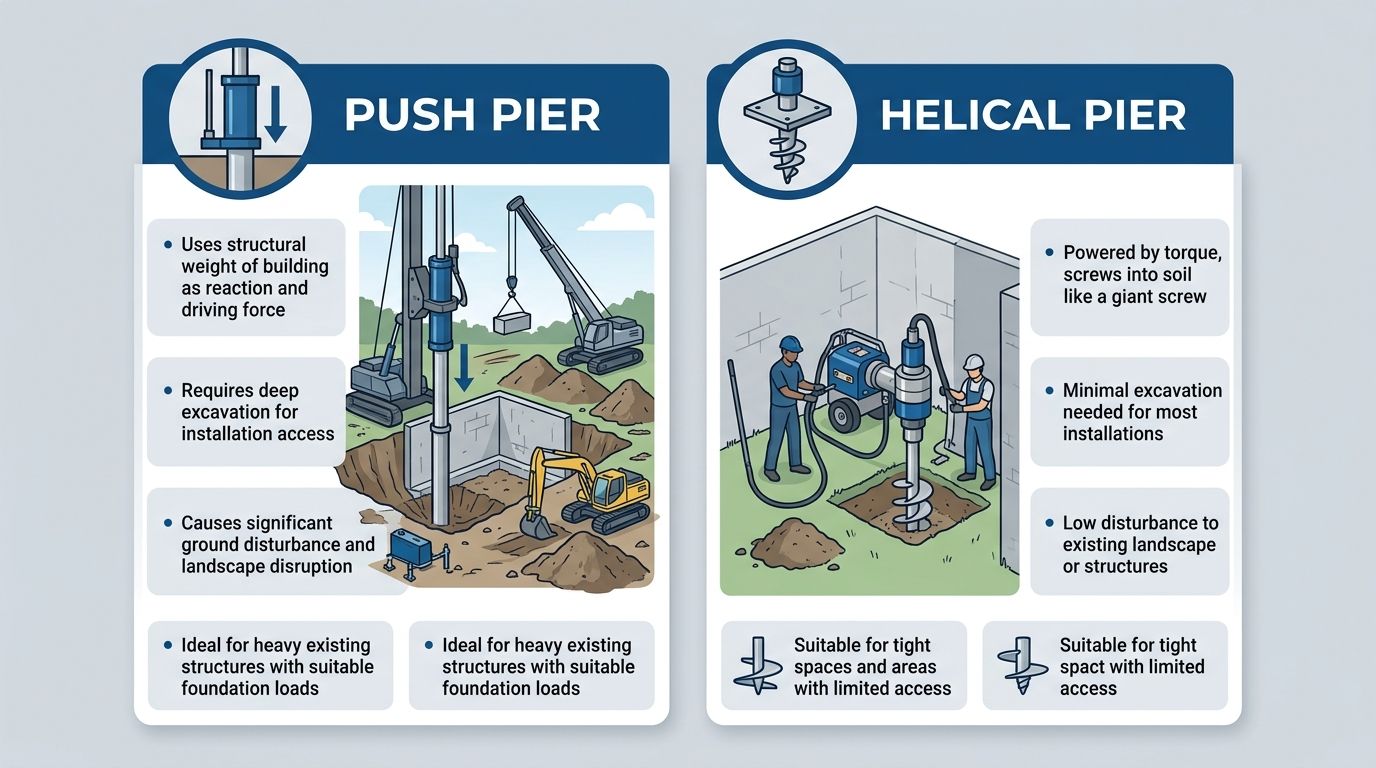
These equipment and logistical differences directly influence long-term costs and maintenance needs, which we explore next.
2. Soil Conditions and Colorado Geology
Beyond the basic foundation types, Colorado’s unique soil conditions play a decisive role in the success and long-term stability of any foundation repair. For homeowners in Centennial making a push pier vs helical pier cost comparison, the geology beneath the home often dictates which method is more appropriate and cost-effective.
In the Colorado Front Range, and particularly in Centennial, expansive clay soils are the primary driver of foundation movement. These soils swell when wet and shrink when dry, a seasonal cycle that exerts tremendous pressure on basement walls and footings. This repeated heave and settlement can crack concrete and shift structural loads in ways that make one pier type perform better than another.
Beyond soil chemistry, local geology such as bedrock depth and groundwater levels also influences pier selection. Helical piers, for instance, can achieve capacity in shallower, looser soils, while push piers require load-bearing strata like bedrock or dense shale. Soil testing and geotechnical reports provide the data needed to match the geology to the right pier, directly affecting overall value.
All foundation repair work must comply with the regulations enforced by the Colorado Department of Regulatory Agencies. This state oversight ensures that contractors meet licensing standards and building codes designed for Colorado’s challenging soils in Centennial. These soil conditions directly impact the performance and cost of each foundation repair method, which we compare next.
3. Structural Weight and Load Capacity
Beyond their basic design, structural weight and load capacity are critical differentiators in the push pier vs helical pier cost equation. Push piers derive their strength by bearing on competent soil strata or bedrock, typically reaching a refusal point of 8,000 to 12,000 pounds per pier, making them well-suited for the heavier column loads of multi-story commercial structures. Helical piers gain capacity through steel plates that distribute weight into the soil, with torque-monitored installation achieving 2,000 to 8,000 pounds per plate pair, a range we often recommend for lighter to moderate loads such as single-story commercial additions. Per guidelines from the NARI remodeling association, a geotechnical analysis is essential to evaluate how soil conditions—clay, sand, or high groundwater—affect load-bearing performance and the total number of piers required. Our experience shows that these engineering differences directly shape material, labor, and installation investments, making the economic differences between pier systems a key factor for commercial foundation planning. If you need guidance on the right pier system for your project’s load requirements, call us 24/7 or Request a Quote today.
These load-bearing capabilities directly translate into the budgetary considerations for pier type, which we examine in the next section.
4. Labor Skills and Local Availability of Contractors
When evaluating contractors for your basement project, understanding push pier vs helical pier cost is crucial for foundation decisions. ACN Construction offers premier basement construction services that bring together skilled labor and local expertise to ensure every project meets the highest standards of quality and durability.
We hire only licensed and insured contractors with specialized experience in basement remodeling. Local contractors who understand Colorado’s specific building codes and climate considerations are essential for code compliance and long-term performance. Comparing push pier vs helical pier cost should be part of any informed conversation, and our team can advise on those foundation method differences while keeping the focus on basement-specific outcomes.
Membership in the Home Builders Association of Colorado demonstrates our commitment to professionalism and industry standards. We also follow best practices from the Professional Remodeling Organization, reinforcing the quality assurance that homeowners expect.
Let us help you get your project started. With the right team in place, the next step is planning your project timeline. Call Us 24/7 or Request a Quote today.
5. Pier Material and Manufacturing Costs
Beyond design, material and manufacturing costs heavily influence which pier system fits your commercial project. When evaluating push pier vs helical pier cost, material and manufacturing differences account for a significant share of the total price. According to NARI cost indices, raw materials and fabrication complexity set the baseline before installation factors come into play.
Push piers typically use steel casing sections filled with concrete after driving. The manufacturing process involves moderate fabrication with standard steel tubing and basic protective coatings. This straightforward approach keeps production costs competitive, making push piers an economical choice for heavy commercial loads.
Helical piers require steel shafts with welded helices, a more complex fabrication process. The precise welding and corrosion-resistant galvanization add manufacturing steps and quality control measures, increasing per-unit cost. However, this upfront investment reduces installation complexity on-site since helices serve as both the cutting edge and load-bearing surface, often eliminating the need for on-site concrete work.
| Pier Type | Material | Manufacturing Complexity | Typical Cost Range (per linear foot) | Best Use Case |
|---|---|---|---|---|
| Push Pier | Steel casing & concrete | Moderate | $150 – $250 | Heavy commercial loads |
| Helical Pier | Steel shaft & helices | High (pre-welded) | $180 – $300 | Low-load or accessible sites |
NARI industry data indicates that custom manufacturing for specific soil conditions—such as corrosion-resistant coatings or larger shaft diameters—adds 15-25% to material costs. Commercial projects often benefit from volume pricing, but the base material and manufacturing differences remain consistent drivers of budget decisions.
While material and manufacturing form the base cost, total project cost also depends on installation, site prep, and long-term maintenance—factors we cover next. Contact us for a detailed material cost estimate tailored to your commercial project: Request a Quote today.
6. Depth of Installation and Bedrock Access
Another major factor driving the push pier vs helical pier cost difference is installation depth and bedrock access. In Colorado, local geology often requires deep foundation work to achieve reliable support.
Push pier installation relies on driving down to load-bearing bedrock for structural integrity. Along the Colorado Front Range, this typically means depths of 10 to 30 feet, though variable soil can shift the range higher. Each additional section of steel adds material and labor, which increases the project total.
Helical pier design often offers more flexibility. Screw piers can stop in competent soil layers once the required design torque values are met, so reaching bedrock is not always mandatory. This shortens material runs and labor time when bedrock sits very deep, giving helical installations a cost advantage in those sites.
Depth alone does not tell the full story—next we examine how soil composition influences which pier type works best. If your remodeling project involves foundation upgrades, our bathroom remodeling services ensure depth requirements are met for long-term stability. For a personalized estimate, feel free to Request a Quote.
Making the Right Foundation Pier Choice for Your Home
When comparing push pier vs helical pier cost, understanding the key differences helps you make an informed decision. Push piers are driven deep to bedrock, offering unmatched stability for heavy structures, but their specialized equipment and deeper installation typically make them more expensive. Helical piers screw into stable soil, making them a more affordable choice for lighter loads and less demanding soil conditions. The right selection depends on your home’s specific soil profile and structural weight—factors best assessed through a professional evaluation.
As an established Colorado construction company, we bring years of experience evaluating foundation issues and recommending the most cost-effective pier solution for your home. Trust expert home remodeling services like ours to guide you from assessment to installation. Request a Quote today, and let us help you get your project started.
Resources
- Get Professional Basement Construction Services
- Get Expert Complete Remodeling Services
- Get Professional Bathroom Remodeling Services
- Get Expert Custom Home Construction Services
- Learn About ACN Construction Services
- Review ACN Construction Terms and Conditions
- Get Expert Kitchen Remodeling Services
- Discover Colorado Home Builders Association Benefits
- Discover NARI Remodeling Association Benefits
- Access Colorado DORA Licensing and Regulation
- Get Centennial Construction Permits Online
- Discover Professional Remodeling Organization Membership