Diagonal Drywall Cracks Above Door Frames: Causes and Solutions
Table of Contents
- What Diagonal Drywall Cracks Above Door Frames Reveal
- Why Diagonal Cracks Form Above Door Frames
- Distinguishing Normal Settling from Structural Issues
- How Diagonal Cracks Relate to Other Foundation Settlement Indicators
- A Practical Framework for Evaluating Diagonal Crack Severity
- Monitoring Diagonal Cracks and Knowing When to Call a Professional
- Taking the Next Steps Toward Your Home’s Foundation Health
What Diagonal Drywall Cracks Above Door Frames Reveal
Diagonal drywall cracks above door frames are a common concern in new construction, often resulting from normal foundation settlement or lumber shrinkage as wood dries and adjusts. While these cracks can be alarming, most are cosmetic and pose no threat to structural integrity.
Hairline cracks that remain stable over time typically need only simple drywall repair. However, cracks wider than 1/8 inch, those paired with doors or windows that stick, or fissures that extend through multiple materials may indicate signs of foundation settlement in new construction. According to the National Association of Home Builders, these patterns warrant professional evaluation.
Unlike diagonal drywall cracks, stair-step cracks in brick mortar typically signal more significant movement in masonry veneer. As ACN Construction, we understand that Colorado’s expansive clay soils make differential settlement particularly relevant for Centennial homeowners. Only an on-site inspection can confirm whether a crack is cosmetic or structural, and we encourage homeowners noticing such cracks to pursue professional assessment.
Why Diagonal Cracks Form Above Door Frames
Diagonal drywall cracks above door frames alarm many homeowners in Centennial and across Colorado. These cracks are typically a symptom of differential foundation settlement—a natural process as a house adjusts to soil conditions. Understanding why they appear and how to evaluate their severity is key to protecting your investment.
When a new home is built, the underlying soil compacts under the weight of the structure—a normal process called settlement. In Centennial and across Colorado’s Front Range, expansive clay soils amplify this effect by swelling with spring moisture and shrinking during the dry summer months. This seasonal movement creates a pumping action that accelerates differential settlement, causing the foundation to move unevenly. To effectively address these diagonal drywall cracks above door frames, it’s essential to understand the role of soil and construction. Door frames interrupt the continuity of wall framing, making the surrounding drywall especially vulnerable to stress. Homeowners should learn to recognize the common signs of foundation settlement in new construction to distinguish benign settling from structural issues. As a result, diagonal cracks radiating from the upper corners of doors are one of the most recognizable signs of foundation settlement in new construction. At ACN Construction, we frequently see this pattern within the first few years after construction. In our design-build projects, we take care to address soil compaction and foundation detailing to minimize such settlement, but older homes often require retroactive evaluation.
It’s important to put these cracks into perspective. Hairline cracks (less than 1/8 inch wide) that do not widen over multiple seasonal cycles are usually cosmetic and can be repaired with drywall tape and joint compound. However, you should monitor for the following structural warning signs:
- Crack width exceeding 1/8 inch
- Visible shifting or displacement of the door frame
- Doors that suddenly stick or no longer latch properly
- Cracks that telegraph through to the exterior brick or stucco
- Cracks wider than 1/4 inch that warrant immediate professional evaluation
These patterns suggest that foundation movement may be ongoing and could require stabilization.
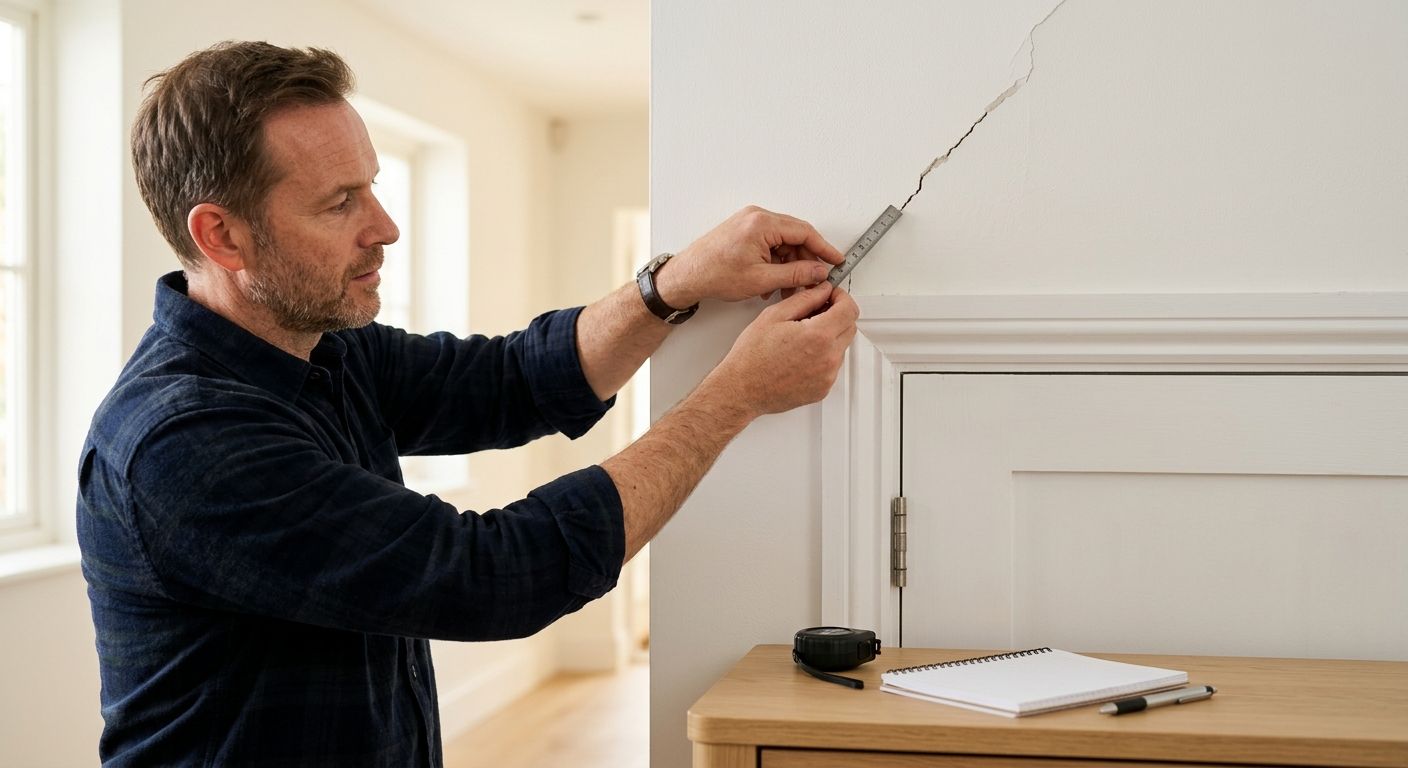
We recommend homeowners document any cracks with dated photographs and a ruler, tracking changes month to month. If you observe growth, displacement, or accompanying symptoms like sloping floors, consult a structural engineer. Early diagnosis often turns a costly foundation repair into a manageable fix. Please consult a licensed contractor for definitive advice and verify licensure with the Colorado Department of Regulatory Agencies (DORA). If you have concerns about cracks in your Centennial home, let us help you get your project started.
While diagonal cracks above doors are one of the most common settlement indicators, stair-step cracks in brick mortar can point to even more significant foundation movement—a topic we will explore next.
Distinguishing Normal Settling from Structural Issues
While many cracks are simply part of normal settling, it is critical to distinguish them from signs of structural trouble. Homeowners throughout the Centennial area frequently ask us about diagonal drywall cracks above door frames, wondering if these are purely cosmetic or indicative of a deeper foundation issue. The reality is that differentiating between harmless settlement and active structural movement requires careful observation of the crack’s width, pattern, and accompanying symptoms.
Normal settling is a natural process, especially in new construction. In the first few months to a year after a home is built, materials adjust to their environment, and the soil beneath the foundation compacts under the structure’s weight. According to our FAQ on stair-step cracks near doors and windows, these signs of foundation settlement in new construction typically appear as minor, hairline-width fractures—less than 1/16 inch wide—that run vertically or in non-continuous patterns. These cracks are stable, do not cause doors or windows to stick, and are rarely cause for alarm.
Structural issues, by contrast, present very differently. As we explain in our guide to stair-step crack concerns, cracks wider than 1/4 inch demand immediate attention. Diagonal drywall cracks above door frames that radiate outward from the corners of openings are a classic warning sign, as our FAQ on common causes of stair-step cracks notes that soil movement, foundation settling, or moisture changes can create these distinctive patterns. More concerning still are stair-step cracks in brick mortar, which follow the mortar joints in a zigzag pattern along the path of least resistance. In our region’s expansive clay soils, freeze-thaw cycles cause the ground to heave and contract seasonally, making Centennial homes especially susceptible to this type of movement. If you notice steeped cracks in masonry accompanied by sticking doors, sloping floors, or gaps around window frames, the foundation is likely experiencing differential settlement—a condition that worsens without intervention.
We advise homeowners to monitor suspicious cracks over a two- to three-month period. Mark the ends with a pencil and measure the width with a ruler. If a crack widens, lengthens, or develops a jagged profile, it indicates an active structural issue requiring professional evaluation. For authoritative guidance on identifying structural cracks in walls, the National Association of Home Builders provides detailed criteria. This information is for general guidance only; please consult a licensed contractor for a definitive assessment of your specific situation. If you suspect structural issues, the next step is a professional assessment—we explain what that involves in the following section.
How Diagonal Cracks Relate to Other Foundation Settlement Indicators
Diagonal drywall cracks above door frames are a common first sign of foundation movement, but they rarely tell the full story. These 45-degree cracks often appear alongside other structural clues, and learning to connect them can help you gauge the seriousness of the problem.
When diagonal cracks appear above door frames, another classic indicator often surfaces on exterior walls: stair-step cracks in brick mortar. Stair-step cracks develop along the mortar joints in a distinctive stepped pattern that, despite its different look from the straight 45-degree drywall fracture, shares a common origin in differential foundation settlement. As the foundation sinks unevenly, tension builds at door and window openings, producing these cracks. In Centennial, CO, the expansive bentonite-rich clay soils that swell with moisture and shrink during dry periods are a common driver of this uneven movement.
These 45-degree drywall cracks above door tops rarely occur in isolation. Sloping or uneven floors often appear in the same part of the house because the same differential settlement that tears drywall can also tilt floor framing. Sticking doors and windows that no longer close properly are another common companion—settlement shifts frames out of square. Superficial hairline cracks under 1/16 inch and isolated are generally cosmetic, but settlement-related diagonal cracks wider than 1/8 inch, appearing in multiple places and paired with other symptoms, demand professional evaluation. In new construction, signs of foundation settlement in new construction such as these signal potential soil-bearing problems and should never be overlooked.
When interior diagonal cracks and exterior stair-step cracks in brick mortar coexist, the likelihood of significant foundation movement is much higher. This combination signals that the entire structure is subject to differential settlement, not just local stress at one opening. A thorough inspection that considers all these interrelated indicators provides the clearest diagnosis.
Understanding how diagonal cracks relate to other settlement signs allows us to deliver a more precise assessment. In the following section, we’ll review repair options tailored to the type and severity of settlement damage. If you’re seeing these symptoms, contact us for a free on-site inspection so we can evaluate your home’s foundation and recommend the appropriate solution.
A Practical Framework for Evaluating Diagonal Crack Severity
When you spot diagonal drywall cracks above door frames, it’s natural to wonder if your home has a foundation problem. Knowing the cause is only half the picture; the other half is assessing how serious the crack really is. The following framework gives you a clear, step-by-step method to gauge severity and decide when to call in a professional.
Severity levels – We group diagonal cracks into three broad categories based on width, displacement, and the materials involved:
- Cosmetic (hairline): Less than 1/16 inch wide, confined to the drywall surface. These are typically caused by natural shrinkage of framing lumber or minor thermal movement. A single hairline crack above a door in a new home is usually normal settling, but repeated cracks in the same spot warrant attention.
- Moderate (1/16 to 1/4 inch): May indicate minor foundation settlement or seasonal soil movement. Watch for changes over time; a crack that opens and closes with the seasons suggests ongoing, though slow, movement.
- Structural (greater than 1/4 inch): Wide cracks with visible displacement, or those accompanied by stair-step cracks in brick mortar on the exterior, almost always point to active foundation settlement. According to the National Association of Home Builders (NAHB), any crack exceeding 1/4 inch in width and showing a stair-step pattern should be evaluated by a foundation specialist.
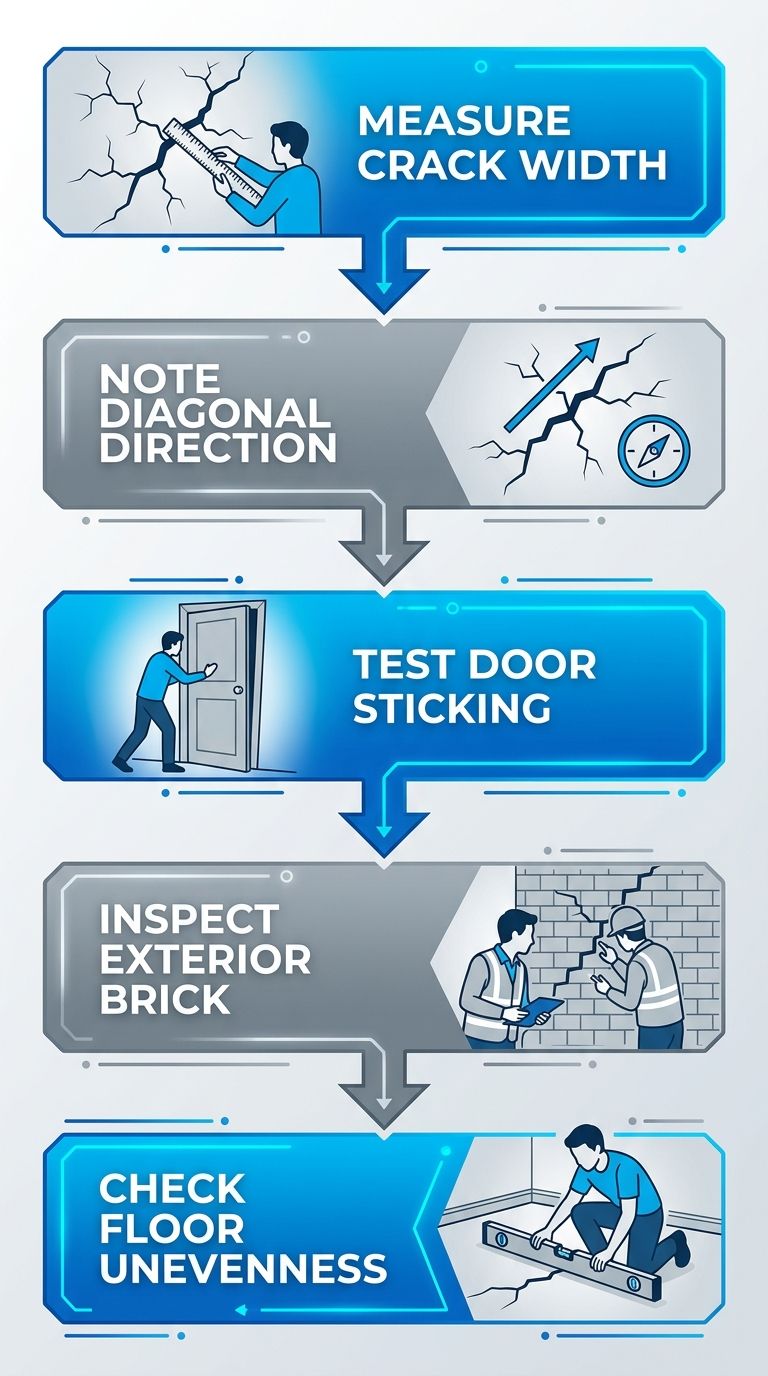
Five-step process for evaluating diagonal crack severity in walls.
To apply this framework, follow these five simple checks:
- Measure the crack width – Use a standard credit card (about 1/32 inch thick) or a ruler. If the crack is narrower than the card’s edge, it’s likely cosmetic; if it’s wider, move to the next steps.
- Note the direction – Diagonal cracks that angle away from the corners of doors and windows often indicate settlement, as the wall loses support above the opening.
- Test doors and windows – Sticking doors and windows that no longer latch smoothly are classic companion signs of foundation movement.
- Inspect exterior brick mortar – Walk around the outside of the home and look for stair-step cracking in the mortar joints. Brick veneer cracks that follow the mortar joints in a step-like pattern are one of the most reliable indicators of differential settlement.
- Check for uneven floors – Sloping or noticeably bouncy floors suggest that the underlying support has shifted, which often mirrors the same movement causing the interior crack.
In new construction, signs of foundation settlement — such as diagonal cracks above door frames and minor drywall seams — are fairly common during the first year as the home adjusts to the soil. However, these should be monitored closely; a crack that continues to widen or is joined by sticking doors and sloping floors points to a deeper issue. Never simply patch a crack without understanding its cause, because masking the symptom can hide progressive damage.
If you discover a crack wider than 1/4 inch, one that is growing, or multiple associated signs, we recommend a professional foundation assessment. For cracks that concern you, ACN Construction offers free walk-throughs and written estimates — we’ll help you understand exactly what the crack means and which stabilization method, whether epoxy injection, carbon fiber reinforcement, or helical piers, suits your situation best.
Monitoring Diagonal Cracks and Knowing When to Call a Professional
Once you identify a diagonal or stair-step crack, monitoring it regularly helps you decide if professional help is needed. Diagonal drywall cracks above door frames and stair-step cracks in brick mortar are common indicators of foundation movement in Centennial homes.
ACN Construction recommends measuring crack width and length at least once a month using a simple tape measure or crack gauge. Record measurements in a log along with notes about changes such as recent rainfall or new sticking doors. This timeline helps you and a professional understand the rate of movement.
- Measure crack width at its widest point and overall length monthly
- Photograph the crack from the same angle each time for visual comparison
Tracking details over several months provides valuable data. Subtle changes that go unnoticed day to day become clear when you review your log.
Stair-step cracks in brick mortar follow mortar joints in a zigzag pattern and signal differential foundation settlement. According to ACN Construction, these cracks are frequently caused by expansive clay soils common to the Denver area and Centennial region. When soil beneath one section shifts more than another, brick veneer cracks along its weakest mortar lines.
Cracks running diagonally from door frames indicate differential movement in the foundation, and signs of foundation settlement in new construction can appear within the first few years as soil fully compacts. Hairline cracks may be cosmetic, but cracks that widen month over month point to active settlement requiring attention.
Certain red flags prompt an immediate call to ACN Construction. Cracks widening beyond 1/8 inch warrant professional evaluation; those reaching 1/4 inch are structurally significant. Other warning signs include sticking doors or windows, uneven floors, and gaps between walls and ceilings.
If your log shows progressive movement over 30 to 60 days, do not wait. Early intervention allows less invasive stabilization such as helical piers or steel push piers, addressing settlement before costly rebuilds become necessary.
If your monitoring shows any of these signs, contact ACN Construction for a thorough foundation evaluation. Let us help you get your project started.
Taking the Next Steps Toward Your Home’s Foundation Health
When you notice stair-step cracks in brick mortar or diagonal drywall cracks above door frames, these signs may indicate foundation settlement that warrants professional attention. At ACN Construction, we understand these patterns often signal differential movement caused by expansive clay soils common in the Centennial area. Left unaddressed, such settlement may lead to more extensive structural damage. Our design-build expertise provides single-point accountability, ensuring your foundation evaluation is thorough and your repair plan is tailored to your home’s needs.
If you have observed these warning signs, we encourage you to request a quote for a professional foundation inspection. Our team can assess your property and provide preliminary guidance—call us 24/7 to discuss your concerns. Estimates are preliminary and subject to change after site inspection and a full scope review. Please consult a licensed contractor for definitive advice, and verify licensure with DORA. Project outcomes may vary based on site conditions and unforeseen issues. Let us help you get your project started.
Resources