Polyurethane Foam vs Steel Piers Foundation Repair: Comparison Guide
Table of Contents
Comparing Polyurethane Foam and Steel Piers for Foundation Repair in Centennial, Colorado
When evaluating polyurethane foam vs steel piers foundation repair in Centennial, Colorado, we compare load capacity, soil compatibility, and long-term reliability. Steel push or helical piers transfer structural weight to competent soil or bedrock, making them suitable for heavy settlement in Centennial’s expansive clay soils. ASCE design criteria confirm that the load bearing capacity of helical piers exceeds what polyurethane foam can support—foam injection in Centennial is typically limited to lifting slabs that have settled 1–3 inches.
While slab jacking vs foundation underpinning represent distinct approaches—foam lifts the concrete, underpinning stabilizes deep foundations—the National Association of the Remodeling Industry (NARI) recommends a structural engineer’s evaluation before choosing either method. Cost factors vary between steel pier types; we detail the differences in our steel push pier vs helical pier cost guide. Given Centennial’s reactive soils, a site inspection is essential. Contact us to schedule a personalized assessment.
1. Permanent Foundation Lifting
When foundation settlement requires lifting, three permanent methods are available for Centennial homes: steel push piers, helical piers, and polyurethane foam injection. The choice between polyurethane foam vs steel piers foundation repair depends on soil conditions, structural load, and the type of foundation issue.
Steel push piers are driven deep to bedrock or load-bearing strata, offering high load capacities for heavy structures. Helical piers screw into stable soil and are often preferred for lighter structures or where bedrock lies deep. The steel push pier vs helical pier cost difference depends on soil conditions, pier depth, and site access—not fixed prices. The load bearing capacity of helical piers varies with helix size, helices count, and soil torque resistance, verified by engineering. For Centennial homes with expansive clay soils, helical piers may need deeper installation to reach stable strata.
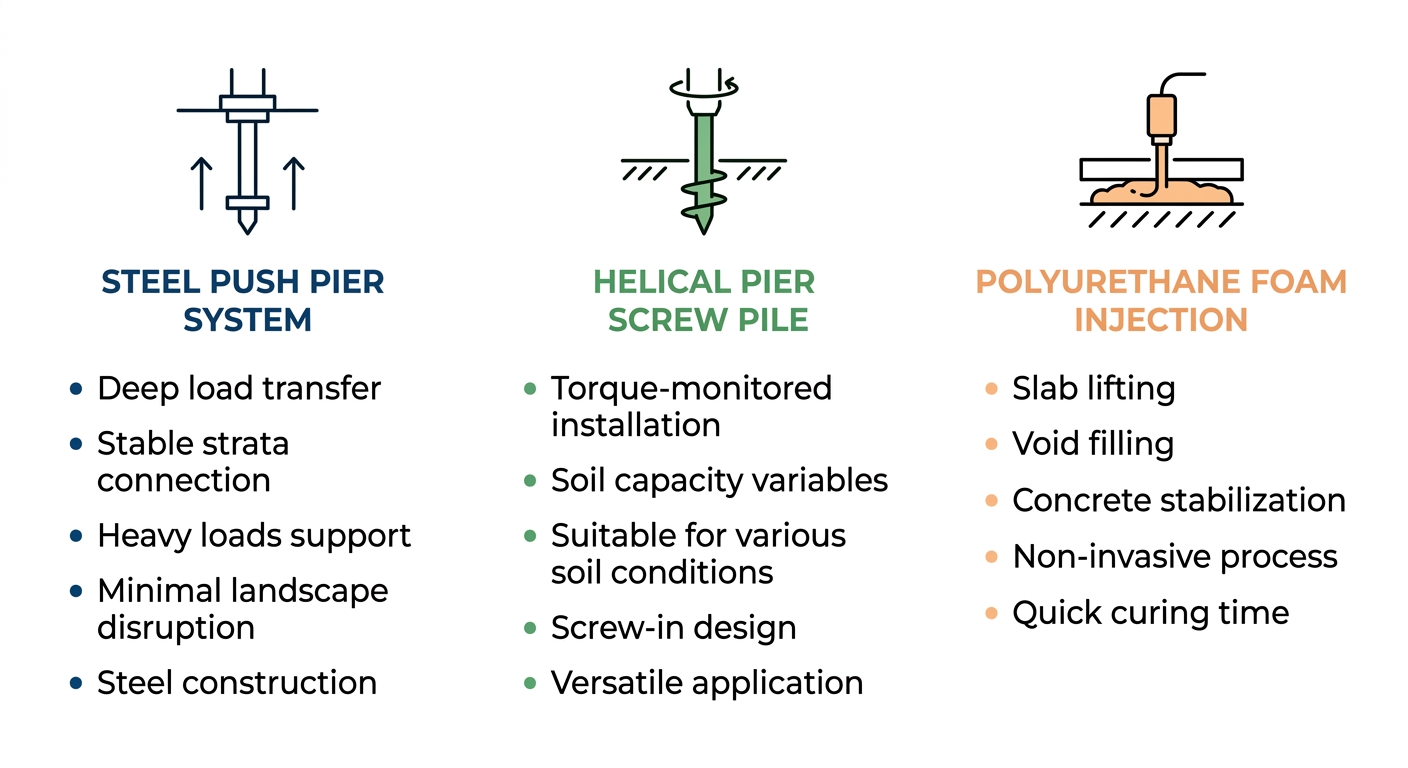
Permanent foundation lifting methods comparison
Slab jacking vs foundation underpinning represents a key distinction: polyurethane foam injection works best for settling concrete slabs and is less invasive, while pier underpinning addresses structural foundation walls. Each method has distinct applications and cost considerations. Let us help you get your project started.
2. Pros and Cons Compared
With an understanding of both methods, let us now compare them directly across key factors. When evaluating polyurethane foam vs steel piers foundation repair, several critical differences emerge. According to the remodeling industry association, cost and performance benchmarks help homeowners weigh their options effectively.
Here is a direct comparison of polyurethane foam and steel piers across key decision factors.
| Feature | Polyurethane Foam | Steel Piers |
|---|---|---|
| Cost | Lower initial cost, but may need reapplication | Higher upfront investment, long-term reliability |
| Lifting Precision | Precise to ±1/8 inch | Precise to ±1/16 inch |
| Soil Suitability | Best for loose, sandy soils | Works in clay, unstable soils |
| Durability | Susceptible to moisture degradation | Corrosion-resistant, life of structure |
| Installation Time | Few hours, minimal disruption | 1-2 days, requires excavation |
Our internal guide at ACN Construction confirms that steel piers generally offer finer control for heavier structures, with load bearing capacity of helical piers reaching up to 8,000 pounds per plate pair. For slab jacking vs foundation underpinning scenarios, site conditions ultimately determine suitability.
Now that you see how they stack up, the right choice depends on your specific soil conditions and structural needs. If you are still unsure, let us help you get your project started with a professional site evaluation in Centennial.
3. Choosing for Uneven Slabs
When faced with an uneven slab, especially in older homes throughout Centennial, the right repair method depends heavily on the foundation’s condition and the underlying soil. For historic properties, the primary goal is stabilization without compromising structural integrity. In many cases, a comparison of polyurethane foam vs steel piers foundation repair reveals that helical piers are the superior choice. Their deep-driven design transfers the structural weight past unstable surface soils to achieve dependable load bearing capacity of helical piers on competent strata, all without heavily disturbing the original foundation.
While slab jacking vs foundation underpinning are both common considerations, polyurethane foam injection has notable limitations for significant settlement. Foam can lift slabs but does not address the root cause of soil instability, potentially leading to recurring issues. This makes it a less permanent solution for the expansive clay soils common in our region. A professional site assessment is therefore critical.
Drawing on our experience with Centennial’s older building stock, we design solutions that comply with home builders association standards for quality and safety. Contact us for a site evaluation to determine the best path forward for your property.
4. Expert Insights on Structural Repairs
From our experience and expert knowledge, we offer these insights on structural repairs. When comparing polyurethane foam vs steel piers foundation repair, our team notes that helical pier stabilization stands out for older homes. The load bearing capacity of helical piers allows these systems to anchor deep into stable soil with minimal vibration to the existing structure in Centennial. For stone foundations, we recommend minimally invasive options like lime-based mortar repointing for material matching, which is a key consideration in slab jacking vs foundation underpinning strategies.
For historic homes, we emphasize that repairing a foundation in Centennial without losing property value requires preserving original character through gentle stabilization techniques. We recommend consulting a civil engineering professional organization for authoritative technical standards to supplement your project research. All advice here is based on general expertise; actual methods must be determined after a professional site inspection because conditions vary.
Ready to discuss your project? Let us help you get started.
5. Stabilization Without Underpinning
When excavation is not desirable, stabilization without underpinning offers effective alternatives for your Centennial property. For many Denver-area homes, the choice between polyurethane foam vs steel piers foundation repair comes down to soil type and load requirements. We evaluate these factors to recommend the least invasive solution.
Polyurethane foam injection uses expanding lightweight foam to lift settled concrete slabs 1 to 3 inches. This method works well for slabs on grade and interior floors where minimal added weight is critical. In contrast, slab jacking vs foundation underpinning presents a different trade-off: slab jacking pumps a cementitious slurry under the slab, effectively filling voids but adding mass. We typically recommend this for driveways and sidewalks in Centennial where heavier lifts are needed.
Helical piers provide deep load transfer without excavation. The load bearing capacity of helical piers makes them ideal for perimeter stabilization of houses and low-rise commercial buildings where access is limited. We screw these steel piles into stable soil, bypassing weak surface layers entirely.
Each method is less invasive and faster than full underpinning, but site conditions determine the best choice. Our next section helps you pick the right approach for your property.
6. Slab Jacking vs Underpinning
When evaluating polyurethane foam vs steel piers foundation repair for your Centennial home, understanding each method’s strengths helps you make an informed decision. Slab jacking, or polyurethane foam injection, lifts settled concrete slabs like driveways and patios, offering a quick solution for lighter loads. Underpinning employs steel push piers driven deep to stable soil, providing the structural support needed for full foundation walls.
Comparing slab jacking vs foundation underpinning, the primary difference lies in application. Slab jacking suits minor settling of non-structural slabs, while underpinning addresses significant foundation settlement and heavier structural loads. The load bearing capacity of helical piers and steel push piers—our standard underpinning solution—far exceeds that of polyurethane foam, as steel piers reach load-bearing strata deep below unstable surface soils.
In terms of cost, our internal data confirms that steel push piers generally represent a higher initial investment than alternative methods because they require deeper installation and offer substantially greater load capacity. However, every foundation issue is unique. We recommend a professional site inspection to determine the right solution, as estimates are preliminary and subject to change after a full scope review.
7. Helical Pier Load Capacity
The performance of these piers ultimately depends on their ability to carry structural loads safely, making the load bearing capacity of helical piers a critical engineering consideration for any foundation repair in Centennial. Each helical pier we install is designed to handle both compressive (gravity) and tensile (uplift) forces, with typical residential capacities ranging from 30,000 to 70,000 pounds per pier. The actual load rating of helical piers for your project is determined by a combination of factors: soil bearing resistance documented in the geotechnical report, pier shaft diameter, helix diameter and number of helixes, and the installation torque we monitor in real time. This torque-to-capacity relationship allows our team to verify that the pier reaches its design load before we secure the foundation bracket. We engineer every helical pier system to meet Colorado building codes and the specific soil conditions of the Centennial area, ensuring the weight supported by helical piers is calculated for long-term stability rather than short-term fixes. Because each foundation presents unique challenges, ACN Construction provides custom load designs based on your site’s specific structural demands. Request a Quote for a free estimate and let us help you get your project started with an engineered solution you can trust.
Making Informed Foundation Decisions in Centennial, Colorado
When comparing polyurethane foam vs steel piers foundation repair in Centennial, your home’s soil and structure determine the right solution. In our expansive clay, slab jacking vs foundation underpinning often points to deep helical or steel piers—a decision that requires a geotechnical report, because the load bearing capacity of helical piers depends on onsite conditions. We always recommend verifying a contractor’s license through DORA and checking for NARI or NAHB affiliations, which reflect adherence to industry standards. Whether your project involves fiberglass window replacement or foundation work, our design-build team manages permitting and inspections—keep in mind that Centennial’s local requirements can shift timelines, and all estimates are preliminary until we complete a site inspection. Let us help you get your project started, and see how we apply these standards to every foundation job.
Resources