Helical Pier Load Capacity Calculations: Essential Guide 2026
Table of Contents
- Helical Pier Load Capacity Calculations: A Homeowner’s Guide
- How Soil Conditions Affect Helical Pier Load Capacity
- The Role of a Structural Engineer in Helical Pier Load Calculations
- Factors That Determine Helical Pier Load Capacity
- Verifying Helical Pier Load Capacity During Installation
- Understanding Theoretical vs. Actual Helical Pier Load Testing
- Building a Strong Foundation: Key Takeaways for Helical Pier Load Capacity
Helical Pier Load Capacity Calculations: A Homeowner’s Guide
Understanding helical pier load capacity calculations is essential for ensuring your home rests on stable ground. According to the Pile Driving Contractors Association, these industry-standard assessments determine the maximum weight a pier can safely support.
Several factors influence load capacity, including soil bearing strength, pier diameter, the number of helices, installation torque, and how deep the piers extend. We at ACN Construction recognize that pinning down the precise helical pier load capacity for your property requires a licensed structural engineer who can interpret complex soil reports and design specifications.
Our team follows PDCA guidelines on every project to deliver reliable installations that protect your home. For homeowners considering larger projects, we also offer window and siding financing options in Colorado to help manage costs. Contact us today to Request a Quote and let us help you get your project started with confidence.
How Soil Conditions Affect Helical Pier Load Capacity
While helical piers offer high load capacity, the surrounding soil conditions play a decisive role in their performance. Understanding helical pier load capacity calculations requires a thorough evaluation of the ground into which they’re installed. At ACN Construction, we recognize that every element of helical pier design and installation depends on precise soil data to achieve reliable structural support.
The distinction between cohesive and granular soils is fundamental to load capacity computation for helical piers. Cohesive soils, like clays, derive their strength primarily from internal cohesion, allowing them to hold together under stress. The Pile Driving Contractors Association (PDCA) notes that in such soils, the skin friction along the pier shaft and the bearing capacity of the helical plates are both influenced by the undrained shear strength of the clay. Stiff, overconsolidated clays provide far greater resistance than soft, normally consolidated deposits. Granular soils, such as sands and gravels, exhibit strength largely through friction between particles. In these materials, the friction angle governs how much load the soil can bear. Dense, well-graded sands achieve high bearing capacities and excellent load transfer, while loose, saturated sands are prone to settlement and reduced capacity.
These helical pier load capacity calculations must account for soil cohesion, friction angle, and how installation torque correlates to soil capacity. Per PDCA guidelines, the torque applied during installation is directly proportional to the soil’s bearing resistance. As the helical plates advance into increasing bearing strata, the required torque rises, providing real-time feedback on the achieved load capacity. This torque-to-capacity relationship, however, shifts with soil type. A given torque value in dense gravel implies a higher load capacity than that same torque in soft clay, because of differences in how each soil transmits shear forces to the pier.
Loose, soft, or saturated soils considerably reduce load capacity compared to dense or stiff soils. Such conditions demand greater pier depth, additional helices, or larger plate diameters to distribute loads over a wider area and reach competent bearing layers. ACN Construction’s field-testing knowledge confirms that without proper geotechnical investigation, these adjustments remain guesswork. Soil borings and lab tests identify the precise soil profile, allowing engineers to design a pier system that meets the target factor of safety.
Seasonal changes also play a subtle but important role. Frost action and moisture variation can alter the stiffness of near-surface soils, potentially affecting shallow helices. That’s why our team carefully considers frost depth and seasonal water table fluctuations when calculating helical pier load capacity, ensuring long-term stability regardless of Colorado’s freeze-thaw cycles.
These soil-dependent factors directly inform the installation torque and depth required to achieve the desired load capacity. For foundation solutions, trust our helical pier expertise; for related exterior work, you can also find a garage door company near me to handle that part of your project. Let us help you get your project started — contact us to discuss your specific needs and to Request a Quote today.
The Role of a Structural Engineer in Helical Pier Load Calculations
While formulas and software can estimate loads, only a licensed structural engineer can finalize the design. Accurate helical pier load capacity calculations are the foundation of any reliable deep foundation system, and a qualified engineer is the professional who transforms soil reports and architectural plans into a workable pier layout. At ACN Construction, we coordinate every step with experienced engineers to ensure your foundation meets site-specific demands and code requirements, giving you confidence before installation begins.
A structural engineer’s primary responsibility is to interpret geotechnical data and translate it into load capacity calculations for helical piers. The engineer evaluates soil bearing capacity, groundwater conditions, and the structure’s dead, live, and lateral loads to determine the necessary number, diameter, embedment depth, and installation torque of each pier. This structural analysis for helical pile foundations distributes building weight safely into load-bearing strata while accounting for settlement limits. The engineer also compares projected capacity against required performance, often applying safety factors of 2 to 3 as dictated by the project type and local codes. In Colorado, designs must comply with the International Building Code, so the professional’s calculations are reviewed during the permit process.
Beyond the numbers, engineers prepare sealed drawings that detail pier spacing, bracket connections, and corrosion protection. The engineer’s seal is typically mandatory for permit approval in most jurisdictions, including municipalities in Colorado, because it certifies that calculating helical pier loads follows accepted engineering standards. At ACN Construction, we work closely with these licensed professionals to integrate their designs into our project schedules. Once the engineer approves the configuration, our crew proceeds with installation knowing the foundation’s capacity has been verified from soil to structure.
Engineer oversight doesn’t just deliver code compliance—it often prevents expensive rework and material waste. To make your helical pier project more budget-friendly, explore our window and siding financing options in Colorado. When you are ready to start, Request a Quote and let us help you get your project started. Once the engineer approves the design, our team moves to installation with confidence in the foundation’s capacity, ensuring your home stands on a secure, professionally engineered base.
Factors That Determine Helical Pier Load Capacity
Accurate helical pier load capacity calculations depend on several key factors that vary from one project site to another. We evaluate these variables thoroughly before any foundation repair or basement remodeling project begins, ensuring that the pier system we design delivers reliable, long-term support.
Soil type and shear strength form the foundation of any capacity estimate. Cohesive soils like clay offer different bearing resistance than granular materials such as sand or silt, and we often encounter mixed profiles across the Denver metro area. Groundwater conditions and frost depth further influence performance, because saturated soils can lose strength and freeze-thaw cycles may shift shallow strata. The helical pier load capacity factors that the Pile Driving Contractors Association identifies in its technical library reinforce how site hydrology and soil composition directly affect final capacity figures.
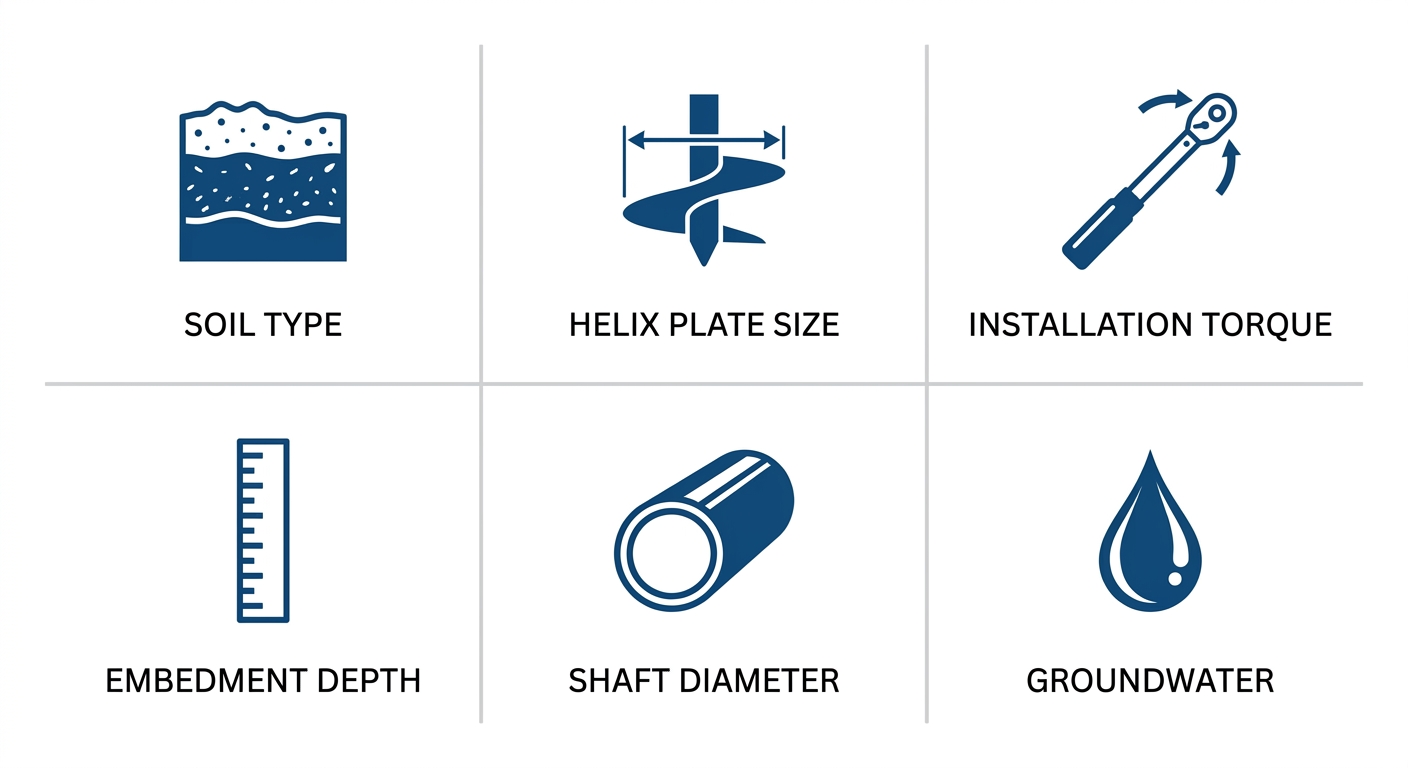
Infographic of six factors influencing helical pier load capacity
Once we understand the subsurface conditions, we turn to the pier’s physical design. Helix plate size and number expand the bearing area, with typical configurations ranging from 6- to 14-inch diameter plates and one to three helices per shaft. Shaft diameter and wall thickness contribute structural strength and buckling resistance, especially when piers must pass through soft upper layers. Embedment depth works hand in hand with these dimensions: deeper installation usually increases capacity by reaching competent bearing stratum, and we verify that depth through torque monitoring and soil log review.
Installation torque provides a practical field correlation for capacity estimation. We rely on the accepted empirical relationship, often expressed as a torque-to-capacity ratio, to confirm that the pier achieves design resistance during continuous rotation. Monitoring rate of penetration and using real-time torque indicators allow us to catch anomalies before the pier is fully seated, and we supplement these checks with load testing when site conditions warrant additional verification.
These variables explain why no two basement underpinning projects are identical. Understanding site-specific conditions forms the basis for accurate helical pier load capacity calculations, and we apply this knowledge to every residential foundation we support. Let us help you get your project started.
Verifying Helical Pier Load Capacity During Installation
During installation, verifying that each helical pier meets the required load capacity is critical for foundation safety and long-term structural performance. The process relies on established engineering principles and real-time field monitoring to confirm that every pier develops the strength specified in the design. For property owners researching helical pier load capacity calculations, understanding these verification methods provides confidence that foundation work meets professional standards while protecting the investment in home remodeling projects.
We use the torque correlation method as our primary real-time verification tool. As detailed in our internal company guidelines, the final installation torque, measured in foot-pounds, is multiplied by a factor that typically ranges from 10 to 12 for helical piers to estimate the ultimate capacity. The installation torque must meet or exceed the design torque identified in the engineering plans for the project. If the measured value falls short of the required threshold, we flag the discrepancy immediately so the design team can determine whether the pier needs to be driven deeper, replaced, or supplemented with additional foundation support.
Continuous monitoring of several parameters is essential throughout the installation process. Our team tracks torque, depth, and penetration rate using a torque indicator mounted on the drive head. This instrumentation allows us to observe changes in soil conditions and detect any anomalies that could compromise performance. If the torque drops suddenly or the pier begins to deflect laterally, installation must stop and an engineer must be consulted before work continues. All torque readings are documented for each pier and compared against the required values, creating a quality control record that becomes part of the permanent project file.
While torque correlation provides reliable capacity estimates for most installations, there are situations where it is not sufficient on its own. When soil conditions are variable or when a project demands a higher level of certainty, we perform load testing on a representative sample of piers, typically at least one per project or approximately two percent of the total installed. This approach, which we apply in basement remodeling applications where helical piers provide foundation support, follows industry best practices and our internal installation guidelines.
Once verification is complete, the next step is to prepare for any required load testing or to protect the installed piers before backfilling and proceeding with the remainder of the foundation work. A documented installation record and confirmed capacity give owners and engineers the assurance they need to move forward. For expert assistance with your helical pier project, Request a Quote or Call Us 24/7.
Understanding Theoretical vs. Actual Helical Pier Load Testing
Understanding helical pier load capacity calculations begins with theory but must be validated in the field. Theoretical capacity estimations are derived from soil mechanics principles, combining the bearing capacity of each helix plate with the shaft friction along the pier’s length. Engineers use torque-correlation formulas, which relate the installation torque to the ultimate capacity based on empirical factors. This initial step provides a projected performance model that guides the design of a foundation system.
However, these theoretical models rely on underlying assumptions about homogeneous soil conditions and consistent installation torque factors. In practice, actual testing is the only way to confirm that these calculations translate into a safe, reliable foundation. Field-tested capacities are determined through direct on-site experiments. Common load testing methods include compression tests, where a downward force is applied to measure the pier’s resistance to settlement, and tension tests, which assess the pier’s ability to resist uplift forces. Lateral load tests may also be conducted to evaluate resistance to horizontal movement. According to the Pile Driving Contractors Association (PDCA), these standardized procedures provide the definitive measure of a helical pier’s performance in its specific installed environment.
Discrepancies between theoretical predictions and actual load test outcomes are common and expected. The primary cause is soil variability; even a detailed geotechnical report provides a snapshot that cannot capture every subsurface anomaly. Installation effects, such as soil disturbance during the screw-in process, can also temporarily alter the bearing medium’s characteristics. Furthermore, the assumed torque factor, which is central to many theoretical helical pier load capacity calculations, can vary significantly from site to site. At ACN Construction, we use theoretical analysis as a foundational planning tool, but we only finalize our designs by verifying them against hard field data. This commitment to field verification ensures that the foundation system meets PDCA guidelines and provides the structural integrity your project demands.
Field load testing is an indispensable validation step that transforms engineering estimates into confirmed performance. It provides the peace of mind that comes from knowing your foundation is built on measured strength, not just paper predictions. Let us help you get your project started.
Building a Strong Foundation: Key Takeaways for Helical Pier Load Capacity
The key takeaways for helical pier load capacity calculations center on three essential factors that determine foundation performance: soil bearing capacity, pier shaft geometry, and installation torque. Each element works together to create a stable support system that prevents settlement and structural damage over time. We emphasize that accurate load capacity estimation for helical piers requires professional site evaluation and engineering oversight to ensure reliable results across diverse soil conditions and load requirements.
Soil bearing capacity establishes how much weight the surrounding earth can support, varying significantly between clay, sand, and rock substrates. Pier shaft geometry—including diameter, wall thickness, and helix plate configuration—directly influences how loads transfer from the structure into the ground. Installation torque provides real-time verification during placement, correlating with capacity through established engineering relationships. Calculating helical pier capacity correctly prevents costly future repairs and ensures foundation stability for projects ranging from light residential additions to heavy commercial structures.
At ACN Construction, we apply these principles in our basement remodeling and custom home foundation work throughout the Centennial area. Our design-build approach integrates helical pier support when existing foundations require reinforcement or new construction demands deep foundation solutions. Let us help you get your project started. Request a Quote today.
Resources
- Contact ACN Construction for Window and Siding Financing
- Contact ACN Construction for Garage Door Services
- Find Expert Window and Siding Financing from ACN
- Contact ACN Construction for Kitchen Remodeling
- Get Kitchen Remodeling Help from ACN Construction
- Contact ACN Construction for Basement Construction
- Learn About ACN Construction and Their Services
- Get Helical Pier Load Capacity Factors from PDCA