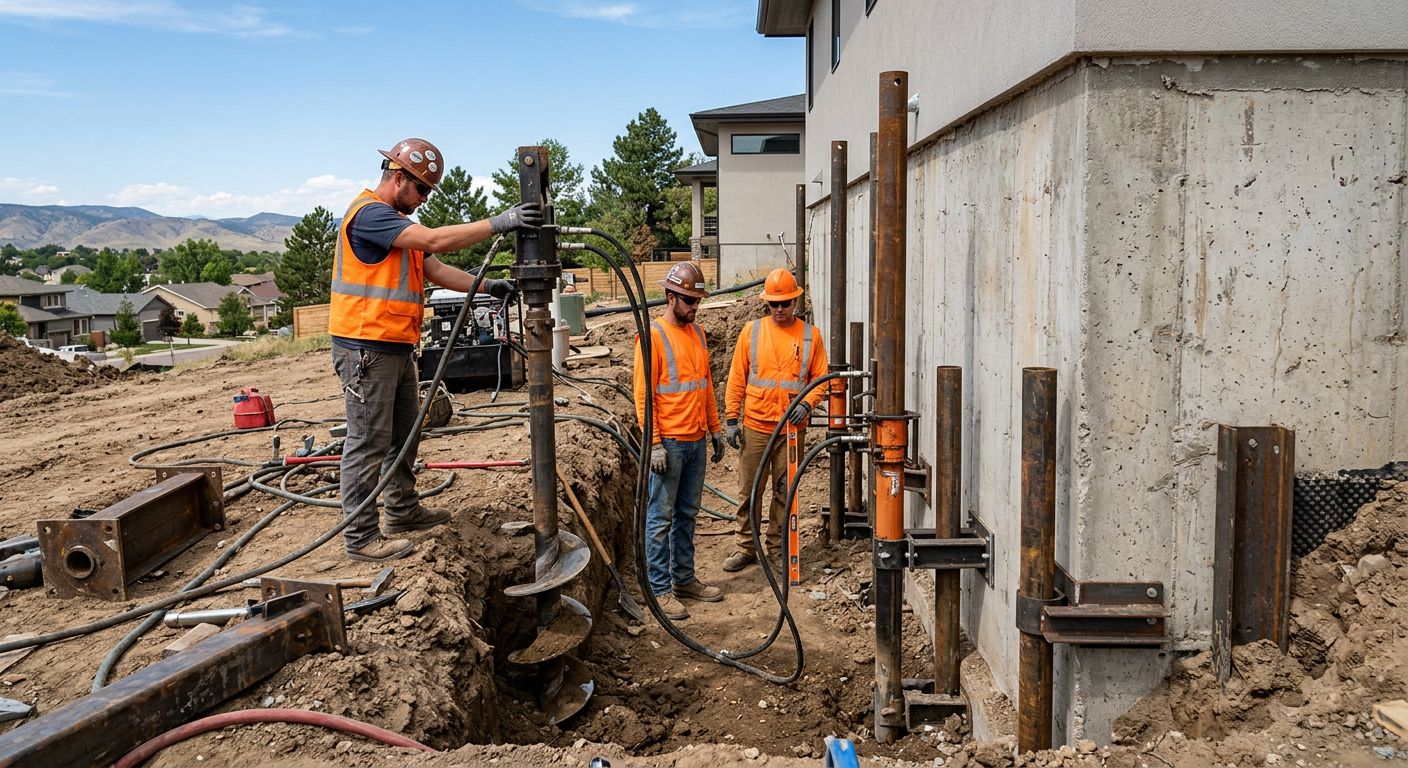
Steel Push Pier vs Helical Pier Cost: Comparison Guide for Centennial
Table of Contents
- Comparing Steel Push Pier vs Helical Pier Costs for Foundation Repair in Centennial, Colorado
- Push Piers and Helical Piers: Key Differences and Cost Factors
- Benefits of Each Foundation Repair Method for Centennial Homes
- How Push Piers and Helical Piers Are Installed
- Choosing the Right Foundation Repair Method for Your Property in Centennial
- Making an Informed Decision on Foundation Repair
Comparing Steel Push Pier vs Helical Pier Costs for Foundation Repair in Centennial, Colorado
As we move from the general landscape of foundation repair, the decision often narrows to a key engineering choice: the push pier vs helical pier cost and performance. We’ll break down what drives the investment for each system in Centennial, Colorado, so you can have an informed conversation about your property’s needs.
Installation Method
Steel push piers are hydraulically driven deep into the earth, using the weight of your structure as resistance. In contrast, helical piers are mechanically screwed into the soil with a rotating drive head, much like a giant screw. This fundamental difference in installation has a ripple effect on everything from equipment choice to labor time in Centennial, Colorado.
Soil Considerations
The expansive, bentonite-rich clay soils common in Centennial, Colorado, play a decisive role in a cost comparison between push and helical piers. The required depth to reach stable, load-bearing strata, which can be significant, is a primary cost variable. The ideal soil type for each method differs, and a site evaluation is the only way to determine which system will perform without issues in your specific ground conditions.
Cost Influencers
Beyond soil depth, several other factors shape your project’s investment. These include site access (whether equipment can navigate your property), the total structural load of your home, and the extent of installation required to stabilize the entire perimeter. We cannot provide a flat price, as every home presents a unique combination of these challenges that must be assessed through an engineering evaluation in Centennial, Colorado.
The table clarifies that while push piers often require deeper penetration and heavier equipment, helical piers offer flexibility in tight-access areas. The optimal choice for your home will be dictated by on-site conditions, not a generic price list.
Making Your Decision
- Your property’s soil composition and expansion potential in Centennial, Colorado.
- Access constraints around the foundation that may limit equipment.
- The engineering requirements needed to permanently stabilize your structure.
Both systems deliver long-term value when correctly engineered and installed. The right answer begins with a precise diagnosis. Let us help you get your project started. Our team at ACN Construction provides the site-specific engineering evaluation necessary to deliver a reliable, custom quote. Please remember, all estimates are preliminary and subject to change after a full site inspection and a written scope review. As we discuss how to choose between these piers in the next section, we invite you to contact us now to schedule your expert foundation assessment in Centennial, Colorado.
Push Piers and Helical Piers: Key Differences and Cost Factors
When foundation settlement threatens a Centennial home, push piers and helical piers offer two proven stabilization methods. Each brings distinct advantages depending on the structure, soil conditions, and budget.
What Are Push Piers and Helical Piers?
Steel push piers are hollow pipe sections hydraulically driven through unstable surface soils until they reach load-bearing strata or bedrock. Connected end-to-end, these assemblies transfer a structure’s weight downward past problematic soil layers. According to ACN Construction’s foundation data, push piers are commonly specified for existing homes experiencing significant settlement, as the hydraulic ramming process can lift and stabilize foundations that have already shifted.
Helical piers use screw-like steel shafts with pre-welded helices that rotate into the ground much like a corkscrew. Portable torque motors monitor resistance during installation to confirm proper seating. These systems excel in new construction, lighter additions such as decks, and sites with limited access, including crawl spaces where heavy equipment cannot fit.
The table below summarizes the key differences between push piers and helical piers across factors critical for Centennial homeowners.
| Feature | Push Piers | Helical Piers |
|---|---|---|
| Typical Load Capacity | Up to 100 tons per pier (depends on soil bearing strength) | Comparable capacity; varies with helix size and soil conditions |
| Installation Method | Hydraulic ram pushes pier sections to refusal or load-bearing strata | Screw-in installation; requires torque measurement for proper seating |
| Ideal Soil Conditions | Compressible soils, clay, fill that requires significant settlement correction | Loose sands, soils with high water table; excellent for new construction or lateral loads |
| Average Cost Range (per pier installed) | (potentially higher mobilization and engineering costs) | (often lower due to faster, less invasive installation) |
| Lifespan & Warranty | 50+ years with proper installation; manufacturer warranties range 10–25 years | 50+ years; similar warranty terms; galvanized coating resists corrosion in moist soils |
Both systems deliver 50-plus years of service with proper installation, yet their cost profiles differ substantially. Push piers command a premium due to heavier equipment and deeper excavation, while helical piers typically cost less with faster installation. These tradeoffs become especially relevant when Centennial’s soil conditions influence the final project scope.
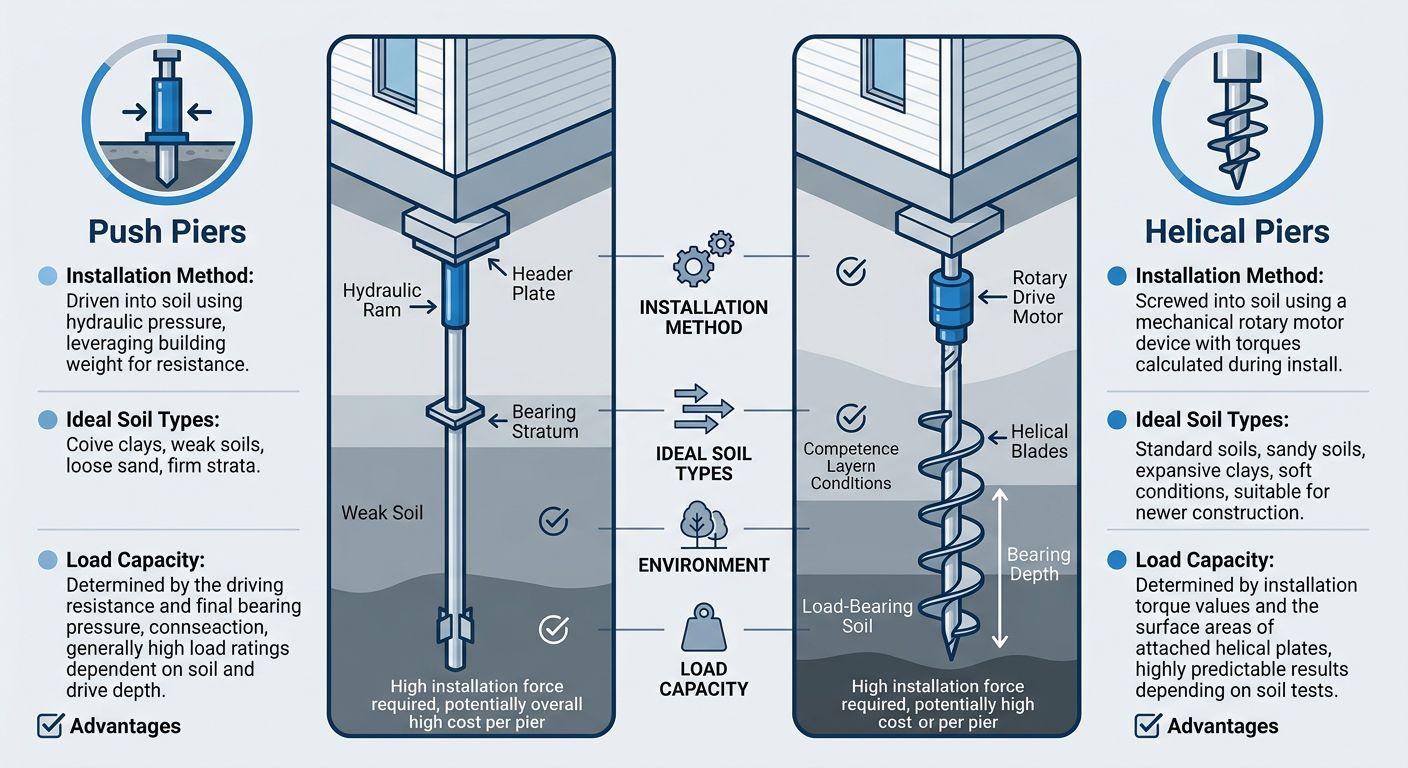
Push piers vs helical piers: key differences in foundation repair methods.
Cost Differences: Steel Push Piers vs Helical Piers
When evaluating steel push pier vs helical pier cost, homeowners in Centennial should weigh both per-pier pricing and the broader installation factors that shape the total project budget. From our field experience, steel push piers typically range per installed pier, reflecting heavier hydraulic machinery, deeper excavation, and specialized engineering. Helical piers generally deploy with faster installation and reduced site disruption contributing to the lower end.
For a detailed breakdown of helical pier vs push pier cost, see our FAQ. These figures represent preliminary estimates. Every project requires a thorough site inspection to evaluate soil composition, load demands, and accessibility before we can deliver an accurate quote. Estimates are preliminary and subject to change after site inspection and a full scope review.
The Role of Soil Conditions in Centennial
Centennial sits within Colorado’s Front Range, where expansive clay soils dominate the landscape. These soils swell when wet and shrink during dry periods, driving the cyclical foundation movement that makes pier systems necessary. The steel push pier vs helical pier cost comparison also depends on local soil type, because each system responds differently to subsurface conditions.
In Centennial’s clay and loam soils, push piers often emerge as the recommended choice for existing homes. Their hydraulic driving method forces pier sections through compressible layers until they contact dense shale or bedrock, typically found at depths of 10 to 30 feet across the Front Range. This deep bearing ensures long-term stability even when surface soils continue shifting with seasonal moisture changes.
Helical piers may prove more cost-effective where sandy or loose soils predominate, or where high water tables complicate deep excavation. Their screw-in installation generates less soil disturbance, making them a practical alternative for additions and lighter structures. Understanding these differences helps you choose the right system; next, we will walk through the installation process. Let us help you determine the best pier solution for your Centennial home—request a quote today.
Benefits of Each Foundation Repair Method for Centennial Homes
Choosing between foundation repair methods is a critical decision for any homeowner in Centennial, and the right approach depends on your home’s specific needs and site conditions. While understanding what each method entails is helpful, the real value lies in recognizing their distinct advantages and when one proves more suitable than the other. Considering the latest home renovation challenges 2026, including material cost volatility and supply chain considerations, it is wise to understand which method fits your home best. In our experience, a clear steel push pier vs helical pier cost analysis begins with evaluating the structural demands and site constraints of your property.
Advantages of Steel Push Piers
Steel push piers are an exceptional solution for heavy structures that require deep settlement correction, driving the load past unstable surface soils to reach competent load-bearing strata. This method creates minimal disturbance during installation, as we hydraulically advance the piers using the weight of the structure itself, typically completing the work with less excavation than alternatives. According to best practices recognized by the National Association of the Remodeling Industry (NARI), proper installation is critical to achieving durable outcomes for these deep foundation elements. We recommend steel push piers for multi-story homes and additions in Centennial where significant structural mass demands the deepest, most stable support that bedrock or dense soil provides.
Advantages of Helical Piers
Helical piers offer a faster installation process and immediate load capacity once the helix plates are torqued into the soil, which makes them highly efficient for projects with compressed timelines. They typically present a more affordable upfront investment compared to push piers, and their installation equipment can access tight spaces where larger machinery cannot operate, making them ideal for constrained urban lots common in our Centennial service area. Our team frequently specifies helical piers for lighter structures such as single-story homes, decks, and sunroom additions, where the robust anchoring of screw-like shafts into competent soil is a cost-effective and reliable permanent solution.
How Home Weight Influences the Best Choice
The structural load of your home directly influences the optimal foundation repair method, and we assess this carefully during every site inspection. A multi-story home in Centennial exerts substantially more bearing pressure on underlying soils, which typically makes steel push piers the more cost-effective long-term choice despite a higher initial pier cost, because they drive deeper to bedrock or equivalent load-bearing strata that can safely support the greater weight. For single-story and lighter wood-frame construction, helical piers generally deliver an excellent balance of performance and value, providing immediate stability without the need to mobilize the heavy structural mass required to hydraulically drive push piers. We help you navigate this steel push pier vs helical pier cost evaluation by considering your home’s total weight, foundation type, and local soil conditions to recommend the most practical approach. Let us help you get your project started. Call Us 24/7 to schedule a comprehensive foundation assessment with our Centennial team.
How Push Piers and Helical Piers Are Installed
Now let us look at how each type of pier is installed and what that means for your budget. As a proud member of the remodeling industry association, ACN Construction provides expert installation of push piers and helical piers, bringing design-build accountability to every foundation repair project. The method we select depends on your structure’s weight, the soil conditions, and the load depth required to reach stable strata.
The Installation Process for Steel Push Piers
The installation of steel push piers follows a precise sequence to transfer the structure’s weight down to competent load-bearing soil or bedrock. Our process, drawn from ACN Construction’s field guidance, proceeds in four key stages.
- Foundation Bracket Attachment: We begin by exposing the foundation footing at each pier location. A heavy-duty steel bracket is secured directly to the footing, providing a solid connection point for the hydraulic system and the pier shaft.
- Hydraulic Ramming: Using specialized heavy hydraulic equipment, we drive the steel pier sections through the unstable surface soils. This process continues until the pier reaches load-bearing strata, which in Colorado typically lies at depths of 10 to 30 feet.
- Load Testing: Once refusal is achieved, each pier is individually load-tested to verify its capacity, which can range from 8,000 to 12,000 pounds. This confirms the pier can support the structure’s demands.
- Final Connection: After all piers are driven and tested, we securely connect them to the foundation brackets. The structure’s weight is then transferred onto the newly installed piers, stabilizing the foundation.
The Installation Process for Helical Piers
Helical pier installation uses a rotational screwing method, making it a distinct alternative for lighter structures and challenging soil conditions. According to ACN Construction’s FAQ guidance, the process is methodically monitored to ensure proper load distribution.
- Screwing into Soil: A torque motor is used to rotate the helical pier into the ground. The steel screw plates, or helices, draw the pier downward with minimal soil disturbance, functioning much like a large auger.
- Torque Monitoring: Throughout installation, we continuously monitor the hydraulic torque required to advance the pier. This real-time feedback correlates directly to the soil’s load-bearing capacity, allowing us to confirm the required support level without always needing to hit deep bedrock.
- Load Verification: After the helices are seated in suitable soil, the pier’s capacity, which can reach up to 8,000 pounds per plate pair, is verified. This step ensures the system will provide stable, long-term support.
- Bracket Attachment: Finally, a steel bracket is fitted to the pier shaft and attached to the foundation, locking the structure into the new support system.
Cost Implications of Installation Methods
Evaluating the steel push pier vs helical pier cost involves understanding several key factors that influence a project’s final budget. The installation cost differences stem from the distinct equipment and labor needs of each method.
Labor and Equipment
Labor costs vary because push pier installation typically requires specialized heavy hydraulic equipment and a more involved setup. Helical pier installation, using torque motor drive heads, often allows for a faster, more streamlined process, which may reduce on-site labor hours for smaller residential projects.
Mobilization and Excavation
Mobilization fees cover the transport of equipment to your Centennial property. Push pier projects may involve higher mobilization costs for the heavier machinery. They also can require more extensive excavation around the foundation footing to access the bracket attachment points, adding to the timeline and expense.
Custom Material Requirements
Colorado’s expansive clay soils can mandate custom material requirements, such as corrosion-resistant coatings or specific shaft diameters, which can increase material costs by 15 to 25 percent. A formal geotechnical analysis is frequently essential to define these needs and prevent unnecessary expenses.
It is important to remember that all costs are custom-quote. Estimates are preliminary and subject to change after site inspection and a full scope review. Our team will assess your specific situation to provide an accurate, no-obligation price comparison. Understanding the installation process helps you appreciate the long-term benefits of each system. Let us help you get your project started. Contact ACN Construction today for your free estimate.
Choosing the Right Foundation Repair Method for Your Property in Centennial
Factors to Consider Beyond Per-Pier Cost
While the steel push pier vs helical pier cost difference is often a starting point, several other factors, including soil bearing capacity, structural load, access, timeline, and maintenance, merit equal attention for properties in Centennial. Our area’s clay-rich soils can expand and contract, demanding careful load evaluation. Structural load, determined by your home’s weight and configuration, dictates pier spacing and depth; a structural engineer should calculate this. Access constraints on narrow Centennial lots often favor helical piers, which use compact torque motors and require less headroom than the hydraulic rams needed for push piers. Timeline also varies: helical piers typically install faster if competent soil is reached early, whereas push piers must be driven to a target depth, sometimes 10 to 30 feet. Regarding long-term maintenance, helical piers tend to perform better in expansive soils with less disturbance, while push piers provide greater load capacity for heavy structures. We recommend evaluating these factors with a professional before making a decision.
Evaluating Your Home’s Needs and Soil Conditions
To choose the right repair method, start by obtaining a geotechnical report from a licensed engineer. This report provides critical data on soil bearing capacity, groundwater depth, and expansion potential, key indicators in Centennial’s clay soils. Look for bearing capacity values; low capacity may require deeper piers. Groundwater depth influences corrosion risks and pier longevity. Expansion potential helps predict soil movement and informs whether helical piers’ flexibility or push piers’ deep anchoring is more suitable. Once you have the report, we can help correlate these findings with your home’s structural needs. At ACN Construction, we review geotechnical data alongside your building plans to determine pier type, depth, and layout. This integrated approach ensures the selected method addresses both soil conditions and structural load without redundancy. Remember, site conditions vary, and a tailored solution prevents future settlement issues. Please note that project outcomes and timelines may vary based on site conditions.
Working with a Design-Build Contractor in Centennial
Engaging a design-build contractor like ACN Construction offers single-point accountability from engineering through installation. Instead of coordinating separate design firms and installers, you work with one team that manages every aspect, reducing miscommunication and potential delays. Our local expertise in Centennial’s permitting and inspection processes ensures your project stays compliant with municipal codes. We navigate requirements for foundation work, saving you time and preventing costly errors. Furthermore, our custom-engineered solutions tailor the pier system to your specific soil report and structural demands. Readers can verify contractor credentials through the Colorado Homebuilders Association, which upholds industry standards and helps connect homeowners with qualified professionals. By choosing a design-build partner tied to this association, you gain confidence in the quality of work and code adherence. If you are ready to move forward, contact us for a site evaluation; we will assess your property in Centennial and recommend the optimal foundation repair strategy.
Making an Informed Decision on Foundation Repair
Now that you understand the technical differences, the right choice for your foundation comes down to site-specific conditions. Evaluating the steel push pier vs helical pier cost depends on several variables that must be assessed in person. Our team considers soil composition, load-bearing needs, and job-site accessibility before recommending a solution.
Steel push piers are hydraulically driven to bedrock or stable strata and perform well under heavy structural loads. Helical piers are screwed into the ground and often suit lighter structures or soils where minimal vibration is important. Comparing steel push piers and helical piers without a soils report can lead to an incomplete picture, which is why we never propose a method without first visiting your property in Centennial.
Because every foundation exhibits unique settlement patterns, installation speed and site disruption vary. A licensed contractor evaluation is the only reliable way to compare timelines and scope. Let us help you get your project started with a free site inspection and a custom quote tailored to your home’s exact conditions. Contact ACN Construction today. We are ready to assist you right away.
Resources
- Compare Helical Pier vs Push Pier Costs for Colorado
- Plan for 2026 Home Renovation Challenges in Denver
- Why Helical Piers Are Best for Tight Crawl Spaces
- Key Factors Affecting Foundation Pier Costs in Colorado
- Discover How Building Weight Determines Pier Selection
- How Expansive Clay Soils Impact Foundation Repair Costs
- Compare Helical vs Push Piers for Residential Repair
- NARI: Premier Trade Association for Remodeling Professionals
- Colorado Association of Home Builders: Benefits Overview