Stair-Step Cracks Explained: Causes, Signs, and Repair Options
Table of Contents
- Understanding Stair-Step Cracks in Your Home’s Foundation
- What Are Stair-Step Cracks and What Causes Them?
- Identifying Serious Stair-Step Cracks: When to Call a Professional
- Monitoring and Managing Stair-Step Cracks at Home
- Professional Repair Solutions for Stair-Step Cracks
- Protect Your Home with Professional Foundation Insight
Understanding Stair-Step Cracks in Your Home’s Foundation
Foundation concerns often begin with visible cracks, but not all cracking is the same. Stair-step cracks are a specific type of fracture that follows the mortar joints in brick or block walls, creating a distinctive staircase pattern. When we assess these during an inspection, their presence may indicate differential foundation settlement or lateral pressure from expanding soils, which are conditions common in the Centennial area.
It is important to distinguish stair-step foundation cracks from hairline cracks. While fine, random cracks can result from normal curing, a staircase pattern is more likely structural. This is because the crack chooses the path of least resistance along the mortar rather than breaking through the brick or block itself. As a result, any visible stair-step crack warrants a professional evaluation by a qualified foundation contractor.
The National Association of the Remodeling Industry is an authoritative industry resource for finding vetted professionals. We encourage homeowners to use the NARI remodeling industry directory to identify a contractor whose work meets high professional standards. Getting an informed assessment early is the surest way to understand what is happening and to plan a sound path forward. If you have noticed a developing crack pattern, please reach out to our team. Let us help you get your project started.
What Are Stair-Step Cracks and What Causes Them?
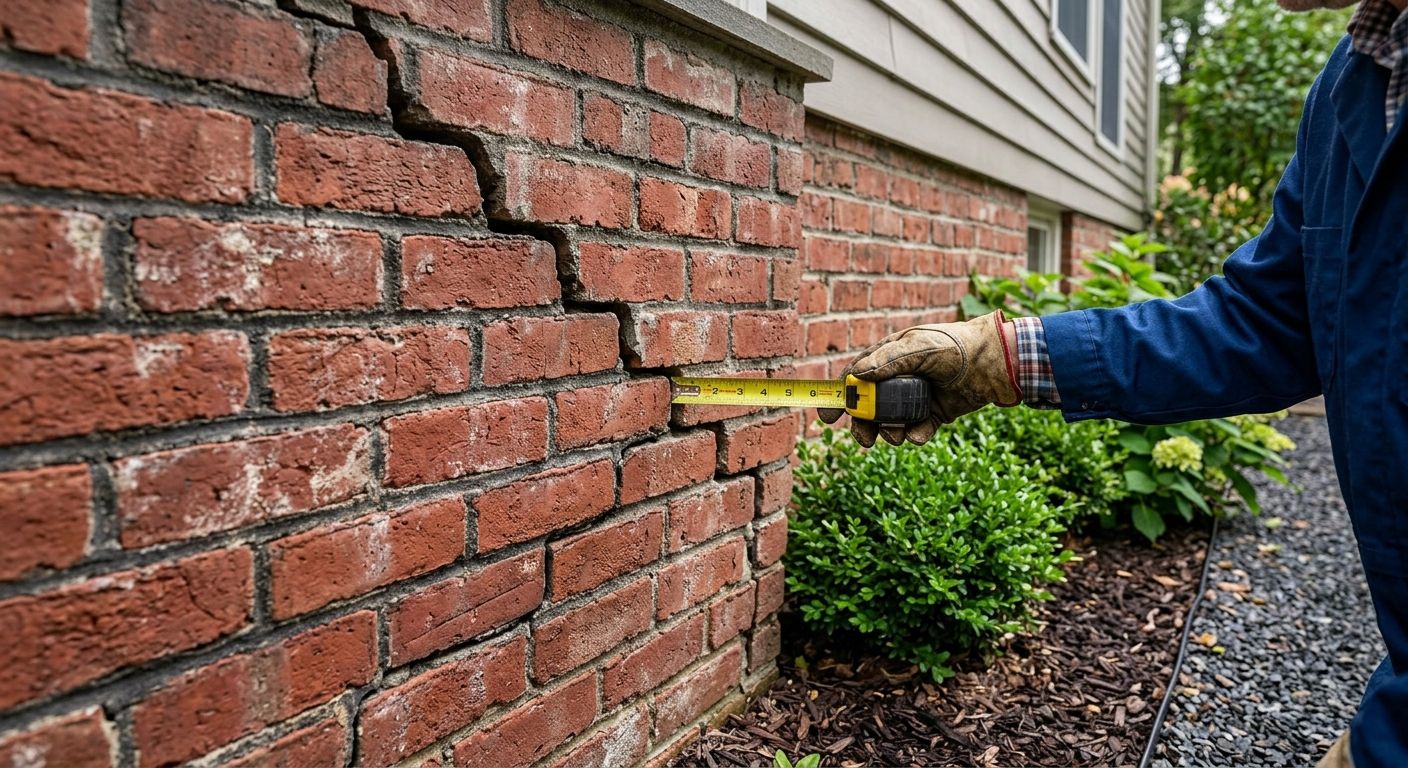
Stair-step cracks are a distinct pattern of diagonal fissures that follow the mortar joints in brick, block, or other masonry walls. Unlike random cracking, this specific pattern resembles a set of stairs, climbing along the horizontal and vertical joints between individual masonry units. We at ACN Construction often see this as a classic indicator of structural movement within a home, and while not every crack signals imminent danger, the stair-step pattern almost always points to differential settlement or external pressure acting on the foundation. Recognizing these cracks early is crucial, as they are a visible symptom of an underlying force that, if left unaddressed, can compromise the long-term stability of your home.
Understanding what causes stair-step cracking is the first step toward a solution. The following table summarizes the most common environmental and structural factors we encounter across the Denver Front Range.
| Cause | Description |
|---|---|
| Foundation Settlement | Downward movement of the foundation due to poorly compacted soil or organic material decomposing under the slab. |
| Expansive Soil | Clay-heavy soil that swells when wet and shrinks when dry, exerting uneven pressure on walls. |
| Hydrostatic Pressure | Water-saturated soil pushes laterally against the foundation, forcing bricks or blocks to separate along mortar joints. |
| Freeze-Thaw Cycles | Water trapped in mortar freezes, expands, and then thaws, gradually widening existing hairline cracks. |
Each of these causes creates a unique stress pattern on your home. Foundation settlement is often the result of construction on poorly compacted or organic-rich soils, a problem that can manifest within the first few years of a building’s life. In our Centennial service area, however, expansive soil is one of the most prevalent culprits. The high clay content in our local ground swells dramatically with moisture and shrinks during dry spells, creating a persistent, cyclical pressure against foundation walls. This uneven force is a primary driver of the stair-step pattern as it pushes and pulls on the rigid masonry. Similarly, hydrostatic pressure from saturated soil after heavy rains or snowmelt exerts a lateral push that can cause walls to bow inward and mortar joints to crack along their weakest path.
These cracks are a reliable indicator of differential movement. Because the forces acting on the wall are not uniform, the cracking follows the mortar joints, which are weaker than the masonry units themselves, creating that tell-tale stair-step pattern. It is important to understand that the crack is a symptom, not the problem itself. While freeze-thaw cycles and minor settlement can cause non-structural hairline cracks, a prominent stair-step crack suggests a more significant and active issue. Applying a superficial patch without addressing the root cause—be it poor drainage, expansive soil, or settlement—will only provide a temporary cosmetic fix before the crack returns.
Identifying the correct cause is essential for choosing the right solution. If you notice these patterns in your home, a professional evaluation can determine the specific forces at play and recommend a permanent fix. Homeowners dealing with stair-step cracks often consider basement remodeling in Denver as part of a comprehensive foundation repair plan, allowing them to address structural issues while transforming the space into a functional, beautiful part of the home. Our team at ACN Construction provides the integrated design-build approach needed to accurately diagnose and correct these foundation challenges. Let us help you get your project started by calling us today to schedule a thorough site inspection.
Identifying Serious Stair-Step Cracks: When to Call a Professional
Recognizing whether these cracks signal serious structural concerns is vital for your home’s safety.
Recognizing Settlement Patterns Near Doors and Windows
Differential settlement — the uneven sinking of different foundation sections — often concentrates stress at the corners of window and door openings. These rigid frames create natural weak points where mortar joints begin to separate in a stair-step pattern. In the Centennial area, expansive clay soils shrink and swell dramatically with moisture changes, making this settlement pattern common. We at ACN Construction frequently observe stair-step cracks radiating diagonally from window corners during inspections. A crack that starts at a corner and steps upward or outward is a telltale sign of differential movement. While hairline cracks less than 1/16 inch may result from normal curing, any crack that widens after rainy seasons or irrigation cycles indicates ongoing soil activity. Documenting these patterns helps you decide when professional evaluation is necessary.
Measuring Crack Width and Movement Over Time
To assess severity, measure the crack’s width at its widest point using a ruler or crack gauge. As a rule of thumb, cracks wider than 1/4 inch are considered structurally significant by most residential foundation contractors. Mark the crack’s ends with a pencil and record the date; then recheck every few months. Movement over two or more seasons indicates active soil or drainage issues rather than one-time settlement. We recommend taking photographs for a visual timeline. Cracks that stay under 1/16 inch and stable for a year are typically cosmetic. However, any widening — even if initially narrow — warrants professional evaluation. During monitoring, also look for sticking doors or sloping floors, which often accompany lateral foundation movement. Regular checks after heavy rains or prolonged drought can catch rapid changes early.
Differentiating Cosmetic from Structural Damage
Discerning between cosmetic and structural stair-step cracks helps you decide whether to call an expert. Cosmetic cracks are typically hairline (less than 1/16 inch), stable for months, and confined to a single mortar joint. Structural cracks, by contrast, span multiple block or brick courses, measure at least 1/8 inch wide, and often come with other warning signs.
| Feature | Cosmetic Crack | Structural Crack |
|---|---|---|
| Width | Hairline (less than 1/16 inch) | Visible gap (1/8 inch or wider) |
| Stability | Stable — no change over months | Active — width increases or lengthens |
| Location | Isolated to mortar joint | Spans multiple courses |
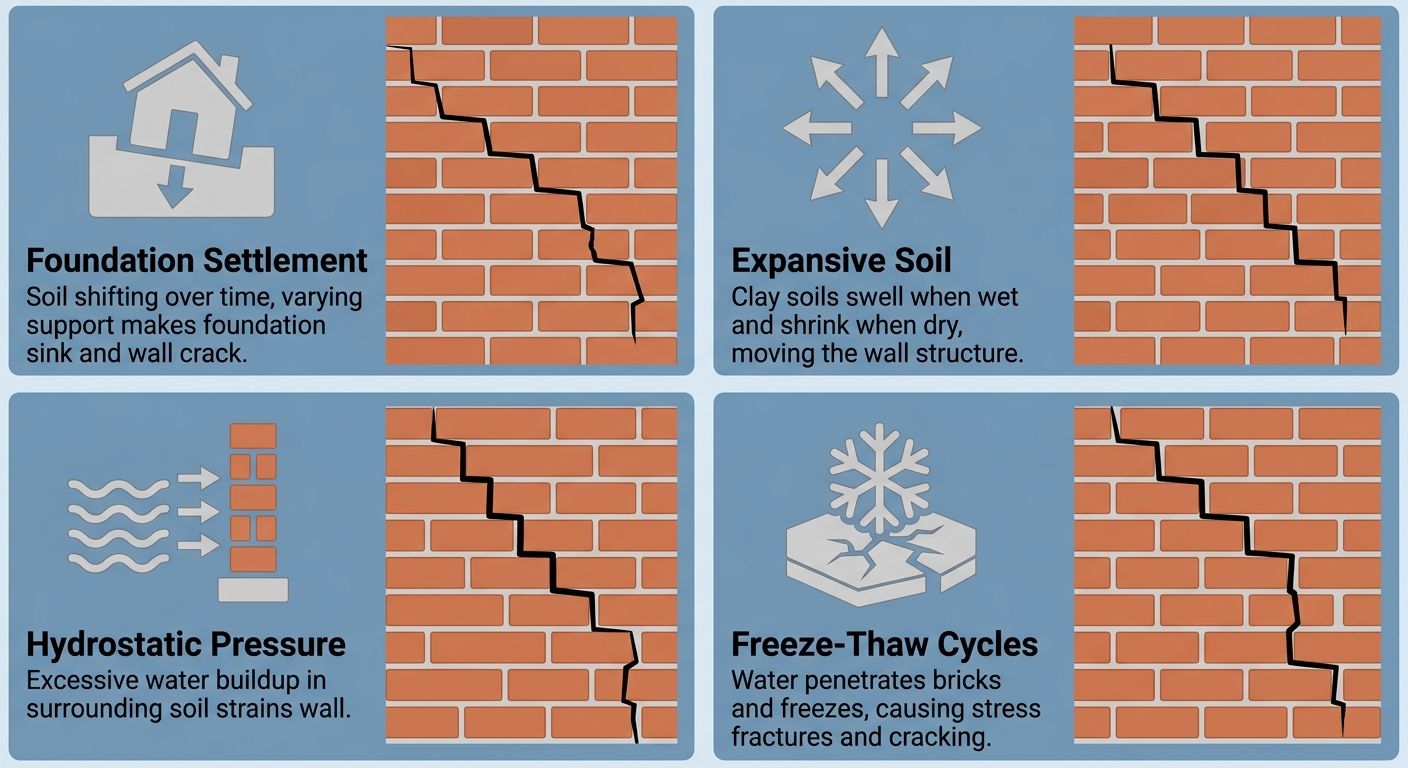
Four common causes of stair-step cracks in brick foundations
When you observe any of these structural red flags, contact ACN Construction for a professional evaluation. Our team performs thorough site inspections to identify the root cause. For confirmed structural issues, we offer foundation repair solutions such as steel push piers and helical piers. Understanding cost factors is essential, so review our guide on steel push pier vs helical pier cost. Call us 24/7 or Request a Quote online — let us help you get your project started.
Monitoring and Managing Stair-Step Cracks at Home
Stair-step cracks in brick walls often signal foundation movement, but not every crack demands immediate professional intervention. Learning to monitor these fractures over time gives you the power to distinguish between harmless settling and progressive structural distress.
Basic Crack Monitoring Techniques
To track changes accurately, you need to record both the width and the pattern of a crack at regular intervals. Begin by marking the crack’s endpoints with a pencil and noting the date. A crack gauge (also called a comparator) is the most precise DIY tool: simply mount the clear plastic scale over the crack and read the millimeter increment at the starting point. For a quicker check, a tape measure can give you the width to the nearest 1/16 inch. Combine either method with photo documentation — take a close-up shot with a ruler held against the crack, then store the image in a dated folder on your phone.
When to Call ACN Construction for a Professional Assessment
Certain signs indicate that a stair-step brick crack has crossed the line from cosmetic issue to structural warning. The most important threshold is width: any crack that measures over 1/8 inch (3 mm) across demands an expert evaluation. Equally urgent is rate of change — if you see measurable widening within a few weeks rather than over multiple seasons, the foundation may be under active stress.
Preventing Further Damage Through Home Maintenance
Often, the best defense against stair-step cracks is controlling water around your foundation. Ensure that downspouts discharge at least six feet away from the house and that the ground slopes away from the perimeter. Clean gutters twice a year to prevent overflow. If you are planning a bathroom remodeling in Denver, coordinate drainage improvements with your contractor. Simple home care habits combined with timely expert input can stabilize hairline crack movement for years.
Professional Repair Solutions for Stair-Step Cracks
Stair-step cracks in masonry foundations indicate differential settlement that needs expert underpinning. We use two proven pier systems—helical piers and steel push piers—to stabilize and restore your foundation.
| Tool | Cost | Accuracy | Best For |
|---|---|---|---|
| Crack Gauge | $5–$15 | High | Precise tracking |
| Tape Measure | $2–$10 | Moderate | Quick checks |
| Photo Documentation | Free | Visual only | Long-term record |
Protect Your Home with Professional Foundation Insight
Stair-step cracks are diagonal fissures in brick or concrete block walls that typically indicate foundation settlement or movement. While not every crack signals a critical issue, these stair-step cracking patterns can reveal structural problems that worsen over time, potentially leading to expensive repairs.
At ACN Construction, we encourage homeowners in the Centennial area to schedule a professional foundation inspection whenever these visible signs appear. Early detection often prevents minor concerns from becoming major structural challenges. Let us help you get your project started.
Resources