

Stair-Step Cracks Explained: Causes, Signs, and Repair Options
Table of Contents
- Understanding Stair-Step Cracks in Your Home’s Foundation
- What Are Stair-Step Cracks and What Causes Them?
- Identifying Serious Stair-Step Cracks: When to Call a Professional
- Monitoring and Managing Stair-Step Cracks at Home
- Professional Repair Solutions for Stair-Step Cracks
- Frequently Asked Questions About Stair-Step Cracks
- Protect Your Home with Professional Foundation Insight
Understanding Stair-Step Cracks in Your Home’s Foundation
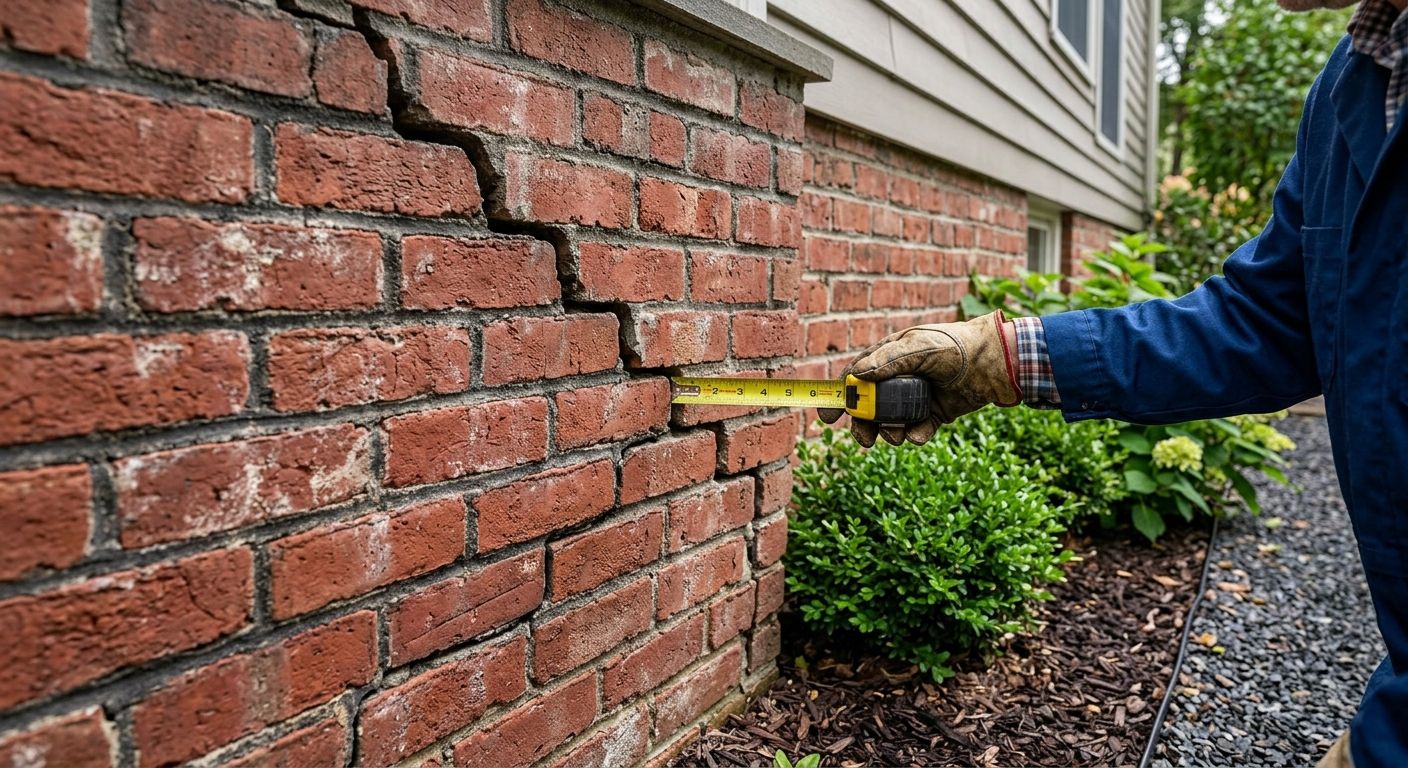
Stair-step cracks are among the most recognizable warning signs that a foundation may be experiencing structural movement. When foundation concerns arise in a home, these distinctive fractures in brick or block walls catch the eye for good reason. Stair-step cracks follow the mortar joints, creating a staircase pattern that runs diagonally across the masonry surface.
Staircase pattern cracks typically indicate differential foundation settlement or lateral pressure against the wall. Unlike hairline cracks, which are often cosmetic and result from normal concrete curing, stair-step patterns in your foundation suggest underlying movement that warrants attention. The soil beneath the home may be shifting unevenly, or expansive clay soils common throughout Colorado may be exerting pressure as moisture levels change with the seasons.
We recommend that any stair-step foundation crack be evaluated by a qualified contractor. While not every crack signals an emergency, these patterns warrant professional assessment to determine whether active movement is occurring. The NARI remodeling industry provides standards and a directory of vetted professionals who can perform thorough foundation inspections. Understanding what these staircase pattern cracks mean is the first step toward protecting your home’s structural integrity. In the sections that follow, we explore how to evaluate these concerns and determine what steps to take next.
What Are Stair-Step Cracks and What Causes Them?
Stair-step cracks are diagonal fissures that follow the mortar joints in brick or block walls. Unlike random hairline cracking, this distinctive stepped pattern is a common indicator of differential foundation movement. When parts of a foundation settle or shift at different rates, the rigid masonry attempts to accommodate the stress by separating along the weakest path—the mortar lines. Understanding the primary causes behind stair-step cracking helps homeowners make informed decisions about whether the damage is cosmetic or requires professional attention.
The following table summarizes the most frequent environmental and structural factors that lead to stair-step cracking in masonry walls:
| Type of Movement | Description of Cause |
|---|---|
| Foundation Settlement | Downward movement of the foundation due to poorly compacted soil or organic material decomposing under the slab. |
| Expansive Soil | Clay-heavy soil that swells when wet and shrinks when dry, exerting uneven pressure on walls. |
| Hydrostatic Pressure | Water-saturated soil pushes laterally against the foundation, forcing bricks or blocks to separate along mortar joints. |
| Freeze-Thaw Cycles | Water trapped in mortar freezes, expands, and then thaws, gradually widening existing hairline cracks. |
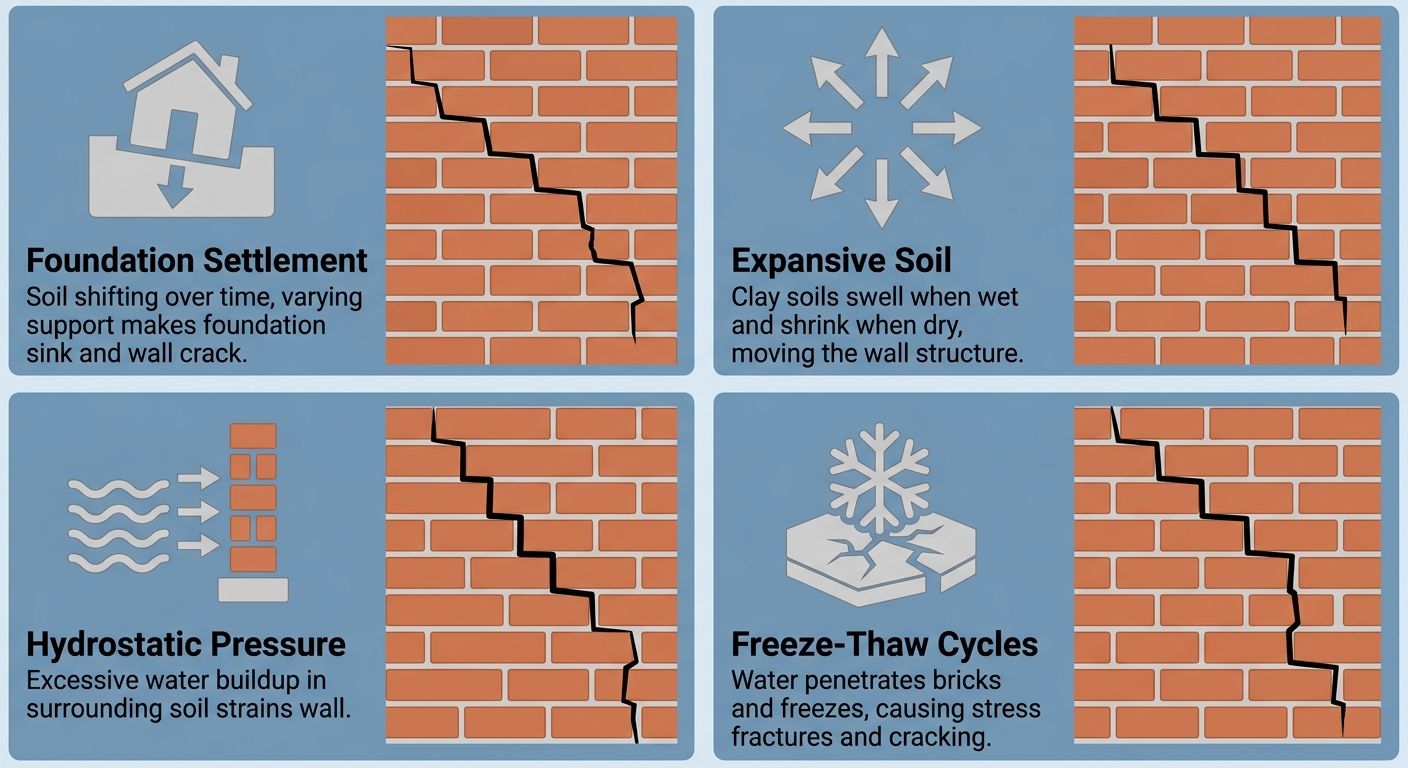
Foundation settlement is most likely to appear within the first few years after construction. When backfill soil around a foundation was not adequately compacted during the building process, it gradually consolidates under the weight of the structure. This uneven consolidation creates differential movement that can twist or tilt a wall, forcing mortar joints to crack in the classic stair-step pattern. In the Denver Front Range region, expansive clay soils add another layer of complexity. These soils are rich in bentonite and other expansive clays that absorb water and swell during wet seasons, then shrink and crack during dry periods. The resulting cyclic pressure pushes foundation walls inward and pulls at mortar joints with enough force to cause noticeable stair-step cracks.
Four common causes of stair-step cracks in brick foundations
Hydrostatic pressure develops when the soil surrounding a basement or crawl space becomes saturated with water. The weight of this waterlogged earth pushes laterally against foundation walls, creating sustained pressure that can separate bricks or blocks along the stepped path of least resistance. In colder months, freeze-thaw cycles worsen any existing cracking. Water that has seeped into tiny mortar gaps freezes and expands, forcibly widening the crack. When the ice melts, the enlarged opening allows more water to enter, and the cycle repeats—progressively degrading the wall’s integrity.
Stair-step cracks are a symptom, not the problem itself. They signal differential foundation movement that should be evaluated by a qualified professional before it leads to more extensive structural damage. At ACN Construction, we understand how unsettling foundation issues can be. Homeowners dealing with stair-step cracks often consider basement remodeling in Denver as part of a comprehensive foundation repair plan, not only to correct the underlying issue but also to create a finished, livable space. Let us help you get your project started: our team can assess the cause of the cracking and recommend proven solutions such as steel push piers or helical piers to stabilize your foundation permanently. Identifying the correct cause is essential for choosing the right repair approach, which is exactly what we cover in the next section.
Identifying Serious Stair-Step Cracks: When to Call a Professional
When inspecting your foundation, stair-step cracks in brick walls or concrete block raise an immediate question: is this a cosmetic issue or a warning sign of structural movement? These zigzag fissures often follow mortar joints, but when they widen or spread, they signal differential settlement—uneven sinking that concentrates stress at wall openings. Knowing how to assess these crack patterns helps you decide if it is time to call a professional.
Recognizing Settlement Patterns Near Doors and Windows
Door and window openings are natural weak points in a wall. The framing creates a break in the continuity of the brick or block, so differential settlement forces the masonry to crack in a stair-step pattern as the ground beneath one side moves at a different rate. You can inspect these areas by sighting along the wall surface. If cracks appear only at corners of openings and remain hair-thin, they may be harmless. However, multiple cracks that extend through the mortar and into the blocks or bricks themselves are a stronger indicator of foundation shifting.
Look for signs beyond the crack itself. Sticking doors and windows that suddenly jam or fail to latch indicate frame distortion from wall movement. When settlement cracks accompany operational issues with openings, the movement is likely affecting the home’s structure, not just a superficial mortar joint. If you notice these symptoms near more than one opening, contact ACN Construction for a professional evaluation.
Measuring Crack Width and Movement Over Time
You don’t need special equipment to start monitoring foundation cracks. A simple ruler or a crack gauge (available at hardware stores) lets you measure the width at the widest point. Document the measurement and the date directly on the wall with a pencil mark or in a home maintenance log. A crack wider than 1/4 inch is generally considered a structural concern by most residential foundation contractors, as it indicates settlement beyond what materials can absorb without damage.
Track the crack over two or more seasons. In Colorado’s expansive clay soils, natural wet-dry cycles cause slight opening and closing. If the crack closes partially during wet months and reopens in dry periods but the maximum width remains stable, the movement may be seasonal and manageable. If you observe the crack lengthening or widening beyond 1/4 inch over a spring-to-fall cycle, the soil or drainage issues are likely active, which calls for a professional assessment.
Differentiating Cosmetic from Structural Damage
Distinguishing a harmless cosmetic crack from structural damage relies on a few clear visual clues. Hairline cracks (less than 1/16 inch) that stay confined to a single mortar joint and show no change over months are usually shrinkage cracks from initial curing. By contrast, structural stair-step cracks often span multiple courses of brick or block and may continue through the units themselves rather than just the mortar. Wall bowing, sloping floors, or cracks propagating diagonally from basement to upper levels are serious signs that the foundation is actively settling.
The table below summarizes key characteristics to help you evaluate the cracks you see:
| Feature | Cosmetic Crack | Structural Crack |
|---|---|---|
| Width | Hairline (less than 1/16 inch) | Visible gap (1/8 inch or wider) |
| Stability | Stable — no change over months | Active — width increases or crack lengthens |
| Location | Isolated to a single mortar joint | Spans multiple courses and continues through brick / block |
| Associated Signs | None | Bowed walls, windows / doors that stick, sloping floors |
A crack that widens beyond 1/4 inch or is accompanied by other warning signs demands professional attention. Monitoring your home’s cracks over two or more seasons helps you determine whether the movement is active, which suggests an underlying soil or drainage issue that will not resolve on its own.
If your assessment points toward structural involvement, the next step is understanding foundation repair methods. ACN Construction’s guide on steel push pier vs helical pier cost explains the difference between deep-driven steel piers and screw-like helical anchors. However, the right choice depends entirely on your home’s specific conditions. We recommend scheduling a professional inspection for a definitive diagnosis and custom solution. Call Us 24/7 or visit our website to Request a Quote and let us help you get your project started.
Monitoring and Managing Stair-Step Cracks at Home
Understanding why stair-step cracks form in your brick foundation is the first step toward protecting your home. Knowing how to track their movement is equally important. Step cracks in brick walls often result from normal settlement and remain stable for years, but without regular tracking you cannot distinguish between harmless aging and progressive foundation movement that demands attention.
Basic Crack Monitoring Techniques
Start by marking the date and location of each crack on a floor plan sketch. Place a crack gauge directly over the widest portion and record the measurement. These inexpensive tools provide precise readings in 0.1 mm increments. Check the same spot every four to six weeks and log each measurement in a notebook.
For quick checks, a standard tape measure works well. Record the crack width to the nearest 1/16 inch. While less precise than a dedicated gauge, this method provides immediate feedback when sudden changes occur. Complement both techniques with monthly smartphone photographs taken from the same angle. Date-stamp each image and save them in a labeled album to create a visual timeline that reveals slow progression numbers might miss.
The following table compares the monitoring tools available to homeowners and when each method delivers the most value.
| Tool | Cost | Accuracy | Best For |
|---|---|---|---|
| Crack Gauge (Comparator) | $5–$15 | High (0.1 mm increments) | Precise tracking over weeks/months |
| Tape Measure | $2–$10 | Moderate (1/16 inch) | Quick width checks |
| Photo Documentation | Free (smartphone) | Visual reference only | Long-term visual record |
| Professional Assessment | Free initial estimate (ACN) | Expert analysis | Final determination of structural integrity |
Crack gauges deliver high accuracy for methodical long-term monitoring. Smartphone photos lack numerical precision but capture wall condition and seasonal changes. We recommend combining all three methods. When measurements remain stable across multiple checks and photographs show no visible growth, the cracks are likely inactive.
When to Call ACN Construction for a Professional Assessment
The critical width threshold is 1/8 inch (3 mm). Once a crack reaches this measurement, structural implications become significant enough to require expert analysis. Cracks that widen noticeably within a few weeks are more concerning than those unchanged for months.
Accompanying signs strengthen the case for professional evaluation. Sticking doors and windows suggest frame distortion from foundation shifting. Uneven floors point to settlement beneath the slab. Gaps between baseboards and walls indicate the structure is pulling away from interior finishes. We offer a free initial assessment for homeowners concerned about stair-step cracks, providing expert analysis that includes a level survey. Our design-build approach evaluates the entire home structure rather than isolated symptoms, giving you a complete picture of your foundation’s condition.
Preventing Further Damage Through Home Maintenance
Preventive maintenance reduces the stress that causes cracks to expand. Start with exterior drainage improvements. Ensure downspouts extend at least five feet from the foundation and soil slopes away at roughly six inches over ten feet. Clean gutters seasonally to prevent overflow that saturates soil adjacent to foundation walls.
Sealing exterior mortar joints with a breathable masonry sealant reduces water intrusion during freeze-thaw cycles. Do not cover active cracks until a professional has evaluated the underlying cause. Filling a moving crack hides the symptom while the structural issue progresses. If you are planning a bathroom remodeling in Denver, coordinate drainage improvements with your contractor to address moisture issues before interior finishes are installed.
Stair-step cracks often remain stable with consistent maintenance and careful monitoring. When measurements stay consistent and no structural signs appear, you can manage the situation with preventive care. If records show progressive widening, foundation repair becomes necessary. Let us help you get your project started with a professional evaluation.
Professional Repair Solutions for Stair-Step Cracks
Now that you understand the cause of stair-step cracks, let us walk you through the professional repair solutions ACN Construction offers. Stair-step cracks in brick or block foundations typically indicate differential settlement — a situation that demands professional underpinning to restore stability and prevent further movement. Ignoring these cracks can lead to escalating structural issues, but our team provides proven, engineered solutions that address the root cause.
We stabilize stair-step foundation cracks with two primary pier systems: helical piers and steel push piers. Helical piers function like large screw-in anchors, making them ideal for loose soils or areas with high groundwater levels; we install them until the required torque capacity is met. Steel push piers are driven hydraulically down to load-bearing strata, which suits compacted soils or sites with shallow bedrock. The table below compares how these methods differ.
| Feature | Helical Pier | Steel Push Pier |
|---|---|---|
| Installation Method | Screwed into soil until torque capacity is reached | Driven / pushed to load-bearing strata |
| Best Soil Type | Loose or soft soil, areas with groundwater | Hard or compacted soil, bedrock near surface |
| Cost Range | Moderate (custom quote) | Generally lower for shallow depth |
| Longevity | 50+ years with proper installation | 50+ years with proper installation |
The choice between helical and push piers depends on soil conditions, load requirements, and site access. ACN Construction provides a free site inspection to recommend the best repair method.
We evaluate your property’s specific soil profile, structural load, and access constraints before recommending the pier type. Our team then delivers a custom quote based on the full scope of work. Please note that estimates are preliminary and subject to change after site inspection and a full scope review. When properly installed, either pier system delivers more than 50 years of reliable foundation stability.
Because we operate as a design-build contractor, you benefit from single-point accountability — engineering, permitting, and construction all flow through one coordinated team. That means we handle everything from the initial geotechnical evaluation to the final quality check. Let us help you get your project started — schedule your free on-site inspection today.
Frequently Asked Questions About Stair-Step Cracks
What are stair-step cracks?
Stair-step cracks are diagonal fractures that follow the mortar joints in brick or block walls, often signaling movement in the foundation or the soil beneath your home. They get their name because the crack appears to climb along the joints like a staircase. While some stair-step foundation cracks are cosmetic, others can indicate more serious structural issues that deserve a closer look.
What causes stair-step cracks in foundations?
These cracks commonly result from expansive clay soils that swell when wet and shrink when dry, exerting uneven pressure on the walls. Poor drainage around the foundation, hydrostatic pressure from saturated soil, or footings that were placed too shallow can also be culprits. In Denver and across Colorado, the region’s reactive soils make these conditions relatively common.
Are stair-step cracks always a sign of serious foundation damage?
Not necessarily. Many step cracks are stable and only affect the appearance of the masonry. However, any crack wider than about 1/8 inch — or one accompanied by sticking doors or windows — should be evaluated by a professional. The National Association of the Remodeling Industry emphasizes working with qualified, licensed contractors for accurate structural assessments.
Who should I call to evaluate stair-step cracks?
We recommend reaching out to a licensed contractor or foundation specialist who understands local soil conditions. A professional inspection can determine whether your cracks are cosmetic or signs of deeper movement. Early assessment often prevents more extensive and expensive repairs down the road, though every situation is unique.
Should I be worried about stair-step cracks in my home?
It’s wise to be attentive without panicking. If the cracks appear suddenly or seem to grow over a short period, it’s time to have them assessed. We advise scheduling an inspection for peace of mind, especially because cosmetic-only cracks should still be confirmed as stable by a pro. Remember, estimates are preliminary and subject to change after site inspection. Please consult a licensed contractor for definitive advice; verify licensure with the Colorado Department of Regulatory Agencies (DORA).
If you’re concerned about cracks in your foundation, let our team provide a professional evaluation. Let us help you get your project started.
Protect Your Home with Professional Foundation Insight
Stair-step cracks are diagonal fissures in brick or concrete block walls that typically indicate foundation settlement or movement. While not every crack signals a critical issue, these stair-step cracking patterns can reveal structural problems that worsen over time, potentially leading to expensive repairs.
At ACN Construction, we encourage homeowners in the Centennial area to schedule a professional foundation inspection whenever these visible signs appear. Our team brings extensive experience in foundation assessment as part of our complete remodeling services, evaluating severity and identifying the underlying cause. Early detection often prevents minor concerns from becoming major structural challenges. Let us help you get your project started.
Resources
- Compare Push Piers and Helical Piers for Foundation Repair
- Get Expert Basement Remodeling Services in Denver
- Get Expert Bathroom Remodeling Services in Denver
- Get Expert Kitchen Remodeling Services in Denver
- Get Expert Bathroom Renovation Services in Denver
- Find Professional Kitchen Remodeling Contractor in Denver
- Get Complete Home Remodeling Services in Denver
- Discover NARI Remodeling Industry Resources and Certification


