

Cost Per Helical Pier Explained: Average Pricing Factors
Table of Contents
- Understanding Helical Pier Costs: A Comprehensive Guide from ACN Construction
- Key Factors That Determine Helical Pier Costs
- How Installation Depth and Soil Conditions Drive Pricing
- Getting an Accurate Helical Pier Quote for Your Project
- Advanced Considerations for Helical Pier Foundation Design
- Common Questions About Helical Pier Costs Answered
- Your Path to a Stable Foundation with ACN Construction
Understanding Helical Pier Costs: A Comprehensive Guide from ACN Construction
The cost per helical pier is not a one-size-fits-all figure; it is a custom calculation that starts with your property’s unique underground conditions. In the Denver and Centennial areas, expenses are influenced by several key variables we evaluate during our initial assessment. Understanding these factors helps you see why a site visit is essential before we can provide an accurate quote.
Several elements drive helical pier pricing:
- Soil composition: Expansive clay or rocky substrates require different pier depths and torque requirements.
- Pier quantity and depth: The structural load of your home dictates how many piles are needed and how deep they must go to reach stable, load-bearing strata.
- Load requirements: Heavier structures or additions needing extra support will naturally influence helical pile costs.
- Local permitting: Fees and code requirements through jurisdictions like Denver and Centennial add to the overall helical foundation cost.
Our team’s design-build expertise brings single-point accountability to your project, which often streamlines timelines and reduces the hidden expenses of coordinating multiple contractors. This experience extends to complex scenarios where soil stability is critical for luxury finishes. ACN Construction’s projects, such as our master bathroom spa retreat ideas, often rely on helical piers to create a perfectly level and stable base for high-end tile work and heavy soaking tubs.
We provide custom quotes following a thorough site inspection and a detailed scope review. Estimates are preliminary and subject to change after site inspection and a full scope review. Please consult a licensed contractor for definitive advice; verify licensure with the Colorado Department of Regulatory Agencies (DORA). Once we understand your project’s specific demands, we can present you with a clear path forward for helical pier installation.
Key Factors That Determine Helical Pier Costs
The cost per helical pier in the Denver area is shaped by four core variables: installation depth, soil conditions, pier size and material, and site accessibility. At ACN Construction, our design-build approach begins with a thorough site inspection that evaluates each of these elements to prepare a detailed, project-specific estimate.
- Installation Depth — directly proportional; deeper installations require more materials and labor.
- Soil Conditions — sandy or loose soils may increase pier count; rocky conditions raise drilling costs.
- Pier Size & Material — larger diameters and galvanized steel increase per-unit price.
- Site Accessibility — limited access adds mobilization and equipment fees.
The following table summarizes how each factor directly influences the investment required for a helical pier foundation:
| Factor | Impact on Cost |
|---|---|
| Installation Depth | Directly proportional; deeper installations require more materials and labor. |
| Soil Conditions | Sandy or loose soils may increase pier count; rocky conditions raise drilling costs. |
| Pier Size & Material | Larger diameters and galvanized steel increase per-unit price. |
| Site Accessibility | Limited access adds mobilization and equipment fees. |
Installation depth is often the most direct driver because each additional foot of steel and excavation adds both material and labor expense. In Centennial projects, we’ve seen how the depth required to reach competent bearing strata can vary even between neighboring lots, making on-site testing essential. Soil conditions further complicate estimates: loose or sandy soils may demand more piers to achieve the required capacity, while rocky substrates call for specialized drill rigs that increase hourly equipment rates.
Pier size and material selection also plays a significant role. A larger shaft diameter or the use of galvanized steel to resist corrosion will raise the per-unit price, but these choices are guided by structural engineering requirements and local code, not arbitrary upgrades. Site accessibility often catches homeowners by surprise. When a backyard has limited gate clearance or the work zone is tight, our crews must bring in compact machinery or move material manually, adding mobilization and labor time. Much like egress window installation cost, helical pier pricing is heavily influenced by how easily we can reach the work area and the depth of excavation required.
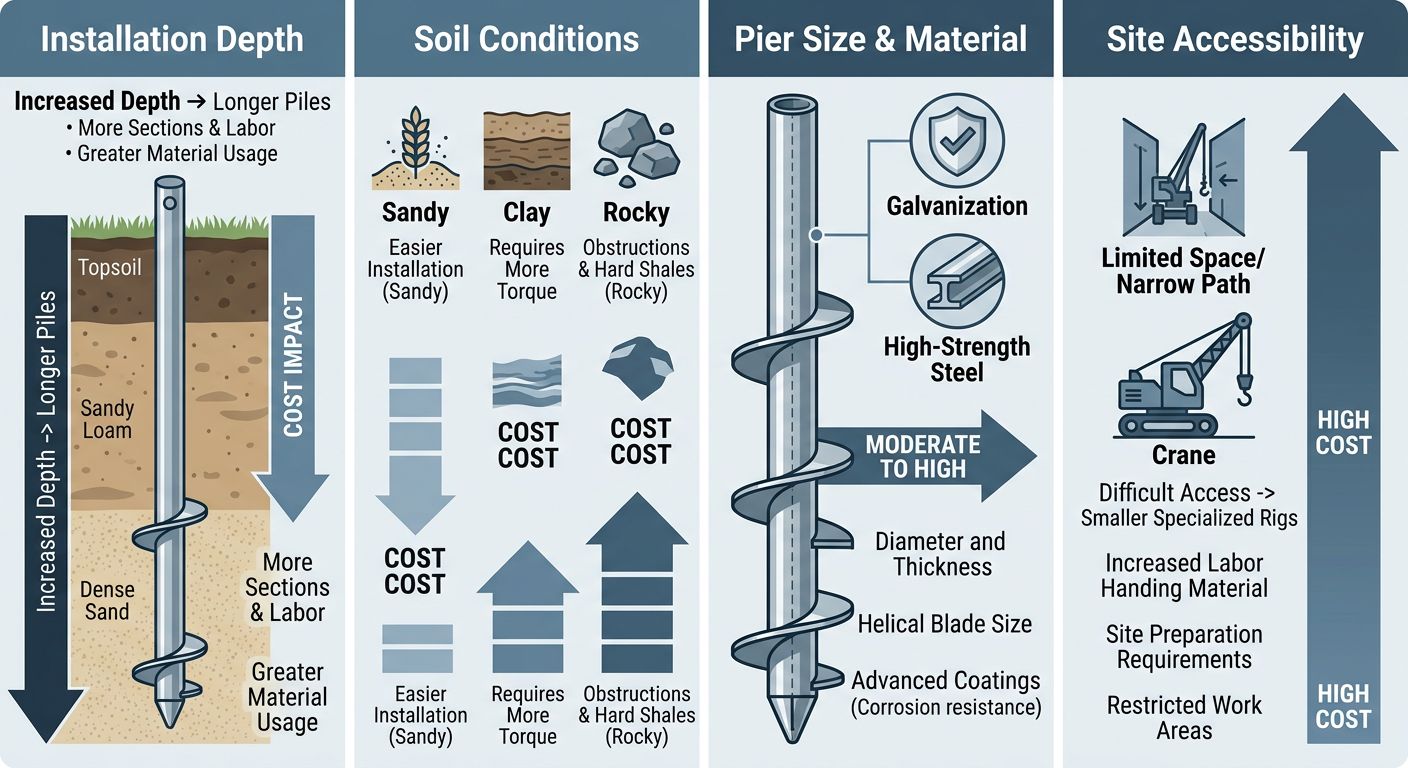
Four-factor helical pier cost infographic with installation depth, soil conditions, pier size, and site accessibility determinants.
The cost per helical pier ultimately reflects the interplay of these four variables; no two sites are alike. That’s why ACN Construction never provides a fixed price without a comprehensive site review. We encourage clients to schedule an assessment so we can map out the exact pier layout, depth requirements, and any logistical constraints. Let us help you get your project started — contact us today for a free estimate and experience the confidence that comes from a properly planned foundation.
How Installation Depth and Soil Conditions Drive Pricing
Beyond basic factors, installation depth and soil conditions play a major role in determining the final cost per helical pier. The price of each pier is not a fixed number; it’s a variable driven by what lies beneath the surface of your Centennial property. From the required drilling depth to the composition of the earth itself, each variable demands specific equipment, materials, and labor. Understanding these site-specific influences helps illustrate why helical pier pricing is always a custom calculation, and why a professional on-site evaluation is essential for an accurate project budget. Let us help you get your project started by exploring these core cost drivers.
How Installation Depth Influences Total Cost
The depth to which a helical pier must be driven is a primary factor in its installation cost. The deeper the target bearing stratum, the more steel is needed, and the longer an installation crew spends on each pier. A standard quote from ACN Construction covers a baseline installation depth, but reaching stable, load-bearing soil often requires extending beyond that initial plan. According to our internal FAQ, the cost for this additional drilling can add an estimated $30–$50 per extra foot for each pier, a figure that accumulates quickly on larger foundation projects. This incremental expense reflects the raw material for extension shafts and the extra hourly labor and equipment runtime.
For projects in Centennial requiring depths beyond 20 feet, the cost implications become more significant. These deeper installations may necessitate a more robust engineering assessment to verify capacity, which is a critical upfront expense. The work also demands larger, more powerful hydraulic drive heads and motors that can handle the increased torque requirements. The combination of these engineering and heavy-equipment factors makes deep installations a key variable in the overall pricing. For example, a project requiring a 30-foot pier will naturally incur substantially higher per-pier costs than one reaching capacity at 15 feet, even with all other conditions being equal.
Soil Type Analysis and Its Role in Pricing
The composition of the soil on your Centennial lot is perhaps the most unpredictable factor influencing per-pier cost. Sandy and loamy soils generally present the most straightforward installation scenario. These materials offer consistent resistance and allow standard hydraulic equipment to drive the pier sections efficiently. In these conditions, the installation process is relatively quick, and costs tend to align closely with baseline project estimates. The predictability helps keep labor hours and equipment usage within standard project scopes.
Conversely, dense clay and silt soils can drive up project costs. These materials create greater frictional resistance against the pier shaft and helix plates, requiring more torque to achieve the designated depth. This may require larger, more powerful equipment and can slow the installation rate, increasing labor time. The most costly scenario involves rock or bedrock. An installation encountering bedrock under Centennial can necessitate specialized rock-drilling equipment or even a pre-drilling process, which significantly escalates both time and cost. Our local geotechnical reports confirm that sites with shallow bedrock demand a fundamentally different, more expensive installation methodology than those with deep, consistent soil layers.
The following table summarizes how these variables interact to influence your project’s relative cost profile.
| Depth Range | Soil Type | Cost Impact |
|---|---|---|
| 10-20 ft | Sandy/loam | Moderate; standard installation achievable. |
| 20-30 ft | Clay/silt | Higher; may require larger equipment. |
| 30+ ft | Rock/bedrock | Significant; drilling and specialized piers needed. |
These comparisons, drawn from ACN Construction job records for local residential foundations, highlight a clear pattern: cost increases in direct relation to both the depth of the installation and the difficulty of the soil. A 15-foot installation in sandy loam is a predictable, moderately priced project, while a 30-foot-plus installation into bedrock represents a complex, significant-cost undertaking. These figures are not fixed, but the relationship between these conditions and the final budget is consistent. A detailed site analysis is the only way to determine where your project falls within this spectrum.
Material Specifications and Their Cost Implications
The physical specifications of the helical pier itself are the final major piece of the pricing puzzle, and these are chosen based on the depth and soil conditions we’ve already explored. The steel gauge, or wall thickness, of the pier shaft is directly correlated with its load-bearing capacity. A deeper installation in heavy clay, requiring a high-capacity pier, will call for a heavier-gauge steel. This thicker material is more expensive to manufacture and purchase than standard gauge, leading to a direct increase in the per-unit cost of the pier components.
Beyond the steel thickness, the pier’s diameter and protective coatings add to the cost. Larger-diameter shafts and helix plates are required for heavier loads or softer soils, increasing the amount of steel in the assembly. In Colorado’s variable soils, corrosion resistance is another critical specification. Piers with galvanized coatings or other protective finishes are essential for long-term durability but add a premium to the base material price. A custom engineering specification for a pier that is 20 feet long, large-diameter, heavy-gauge, and galvanized will represent a substantially higher per-pier cost than a standard, off-the-shelf assembly for a lighter-duty application.
We manage every factor from planning to final finishes. For other foundation-related services like garage door installation, contact our team for a custom quote. Understanding these variables in soil, depth, and material helps you plan your project budget. Please remember that all estimates are preliminary and subject to change after site inspection and a full scope review. Contact us today to Request a Quote and get a precise, on-site evaluation for your specific property.
Getting an Accurate Helical Pier Quote for Your Project
After understanding the types and applications of helical piers, the next practical step is obtaining a reliable quote tailored to your specific foundation needs. The cost per helical pier varies significantly based on soil conditions, depth requirements, and site accessibility, making a custom evaluation essential for accurate budgeting. At ACN Construction, we provide transparent, detailed estimates that reflect real project variables rather than generic averages, ensuring you have a clear financial picture before work begins.
The ACN Construction Quote Process: What to Expect
Our approach to providing a helical pier quote begins with a comprehensive site inspection, where our team evaluates soil conditions, foundation access points, and any existing structural concerns that may influence the installation. Following this evaluation, we develop a written quote that includes a line-item breakdown of materials, labor, mobilization fees, and any specialized equipment required for your property. This transparency eliminates surprises and allows you to understand exactly where your investment goes.
We also review applicable building codes and permitting requirements specific to your jurisdiction, drawing on our familiarity with municipal regulations in Centennial and across the Denver metro area. Because soil conditions in Colorado frequently involve expansive clay that demands deeper pier placement, our estimates account for potential depth variables based on visible site characteristics. Homeowners who have existing soil reports or structural engineer assessments should share these during the quoting phase, as they help us refine the initial foundation quote and reduce the range of potential cost adjustments.
Preparing Your Site for a Helical Pier Installation
Proper site readiness helps ensure an accurate estimate and streamlines the eventual installation timeline. Before we arrive for the site inspection, consider these preparation steps:
- Clear access paths to the foundation area by removing stored items, debris, or overgrown vegetation that could obstruct equipment movement
- Identify and mark any known underground utilities or irrigation lines, though we coordinate with Colorado 811 for official utility locating before excavation
- Gather relevant documentation including property surveys, previous foundation repair records, and soil reports if available
- Note any drainage issues, standing water areas, or seasonal moisture patterns that may affect soil stability around the foundation
- Ensure gate widths and overhead clearances can accommodate installation equipment, particularly for backyard or crawl space access
Sharing as much information as possible about your property’s history and site conditions helps us produce a helical pier pricing estimate that minimizes surprises. Properties with difficult access, such as tight crawl spaces or limited overhead clearance, may require additional labor time that we factor into our quote based on what we observe during the walkthrough.
Comparing Quotes and Choosing the Right Contractor
When evaluating proposals from different contractors, look beyond the bottom-line number to understand what each quote actually includes. The following checklist highlights key elements to compare when reviewing helical pier quotes:
| Item | What to Look For |
|---|---|
| Per-Pier Cost Breakdown | Transparent listing of materials, labor, and mobilization fees. |
| Depth and Soil Assumptions | Clarity on whether quote includes geotechnical assessment. |
| Warranty and Guarantees | Workmanship warranty duration and coverage scope. |
| Permit and Inspection Handling | Whether contractor manages local permitting and inspections. |
When you review our proposals, you will find that we provide detailed line items for each cost category rather than lump-sum figures. This transparency allows you to see what assumptions we made about soil conditions and pier depth, and it gives you a clear basis for comparing our quote against other contractors who may bundle costs differently.
Verifying contractor credentials is equally important as comparing numbers. We recommend confirming that any installer under consideration holds an active license with the Colorado Department of Regulatory Agencies, which maintains a searchable database of qualified professionals. Consider contractors who are members of the NARI remodeling association for added trust and professionalism, as membership signals a commitment to industry standards and continuing education. Our team handles the permitting and inspection coordination for projects in Centennial, ensuring that every installation meets local code requirements without adding administrative burden to your plate.
Once you have selected a contractor and finalized the scope, the installation process can move forward with confidence. At ACN Construction, we manage both the quoting and installation phases under a single design-build contract, eliminating the coordination gaps that often arise when separate firms handle different project stages. This integrated approach means the same team that walked your site and prepared your estimate will oversee the helical pier installation from mobilization through final load testing and certification.
We encourage you to reach out and let us help you get your project started. Every property presents unique conditions, and our preliminary estimates are subject to change after a complete site inspection and full scope review. Request a Quote today to begin the conversation about your foundation repair needs.
Advanced Considerations for Helical Pier Foundation Design
Understanding the factors that influence the cost per helical pier begins with a deeper analysis of the foundation design itself. While the preceding section established the fundamental principles of helical pier systems, achieving a durable and stable foundation in the Centennial area requires careful attention to several advanced design parameters that ensure long-term structural integrity.
Load capacity is not a fixed number but a calculated value determined by the interplay of soil bearing strength, the total surface area of the helix plates, and the depth at which the pier is installed. The deeper a pier is driven, the more competent the bearing strata typically become, allowing for a greater load to be supported by a smaller shaft. We coordinate with licensed structural engineers who use on-site soil data to verify that each pier configuration meets the specific loading demands of your project, as these design factors may influence the overall cost per helical pier.
The soil conditions in Denver and the Centennial area introduce unique challenges that directly inform helical pier design. Our local experience with expansive clay soils, which are prone to significant volume changes with moisture fluctuation, necessitates designing piers with an installation depth sufficient to reach stable, inert strata below the active zone. This prevents future settlement and heaving, a critical consideration that ties into every other design element, from shaft size to corrosion protection.
The configuration of the helix itself involves several critical variables:
- The number and diameter of helix plates on a single pier, which dictate the achievable bearing capacity.
- The shaft size and wall thickness, selected to resist both the installation torque and the long-term structural loads.
- The torque correlation during installation, a real-time field verification that confirms the pier has reached a soil stratum with the predicted bearing strength.
Structural engineering review and certification are non-negotiable for any custom helical pier design. While we do not provide engineering services directly, we manage this essential process on your behalf, ensuring that a licensed Colorado professional engineer reviews the soil report and specifies a pier design that is code-compliant. This certification provides a documented, engineered solution rather than a simple product installation, adding a layer of accountability that professional guidelines, such as those upheld by the National Association of the Remodeling Industry (NARI), emphasize for quality and safety in remodeling.
For long-term durability, especially in the varying soil moisture common to the region, corrosion protection is a vital design consideration. Standard galvanization of the steel shaft offers a baseline level of resistance. However, for sites with aggressive soil chemistry, we may specify additional measures like a thicker galvanized coating or a cathodic protection system, based on the engineer’s recommendation and project’s lifecycle requirements.
Finally, local building code requirements and permitting in Denver profoundly affect design parameters. Our team’s deep familiarity with these local amendments ensures that a pier design not only meets the structural demands but also satisfies jurisdictional review the first time. Navigating these regulations is a core component of our design-build approach, preventing costly revisions later.
These advanced design variables form the technical foundation for a successful project, and each one has a direct, albeit project-specific, relationship to the overall project budget. In the next section, we will build on these helical pier cost factors to explore what goes into a reliable cost estimate, from initial site evaluation to final engineering certification.
Common Questions About Helical Pier Costs Answered
We answer common questions about helical pier foundation costs.
What affects the cost per helical pier?
The cost per helical pier depends on soil conditions, pier depth, number of piers, and site access. A custom quote after a site inspection is the most accurate way to budget.
How many helical piers do I need for my foundation?
The number depends on load requirements, soil bearing capacity, and the design. Our engineering team calculates the exact quantity as part of design.
Do you provide free estimates for helical pier installations?
Yes, we offer free estimates. A site visit lets us review conditions and deliver a preliminary cost breakdown.
Why do helical pier costs vary so much?
Costs vary due to soil strata, depth, equipment access, and local permits. Our Denver and Centennial code expertise helps keep the process predictable.
Estimates are preliminary and subject to change after a full site inspection. Contact us for your custom quote.
Your Path to a Stable Foundation with ACN Construction
Helical piers provide a permanent, cost-effective solution for unstable foundations. The cost per helical pier depends on soil conditions, depth, and design complexity, but the investment delivers immediate load-bearing capacity and minimal site disruption. As a design-build partner, we handle every detail—from Denver/Centennial code compliance to final inspection—so you enjoy single-point accountability. Every project starts with a thorough site inspection and written scope before any pricing commitment. Request a Quote or Call Us 24/7 and let us help you get your project started.
Resources
- Maximize Resale Value with Strategic Bathroom Renovations
- Learn Egress Window Installation Costs and Code Compliance
- Get Professional Garage Door Installation and Disposal
- Discover Hidden Helical Pier Costs Beyond the Quote
- Learn How Site Accessibility Affects Helical Pier Costs
- Find 2026 Whole Home Remodel Costs for Colorado Homes
- Discover Helical Pier Installation Costs in Centennial
- Find Certified Remodelers with NARI Association Resources


