Helical Pier Cost per Pier: 2026 Pricing Guide
Table of Contents
Understanding Helical Pier Cost Per Pier
When evaluating helical pier cost per pier, several factors come into play that determine the final price for each individual pier. The price per helical pier typically ranges in cost based on soil conditions as there is a bit of variation in the Denver and surrounding area. Required depth to reach stable bearing strata, pier diameter and gauge, and overall site accessibility dictate cost. Each pier is priced individually, but since most residential projects need 4 to 12 piers, total cost can shift substantially depending on your property’s unique requirements. Permits and engineering fees are separate line items we always include during quote discussions. Beyond garage door installation, our foundation repairs include helical piers that demand a professional onsite evaluation for accurate per‑pier pricing. For more on our garage door installation services, visit our specialist page and Request a Quote to get your project started.
The Helical Pier Cost Per Pier
When evaluating the helical pier cost per pier, several factors come into play. Pier length, required load capacity, soil conditions, and site accessibility are all key cost drivers. For projects that also involve a garage door installation, foundation costs remain a key consideration—our helical piers provide reliable support at a competitive per-pier price. As detailed in our FAQ, helical piers often represent a more cost-effective solution than concrete piers for certain applications, offering faster installation and immediate load-bearing capability. Understanding the cost factors of each helical pier helps you budget accurately. Request a Quote from ACN Construction for an exact estimate based on your unique project needs and schedule a visit. Let us help you get your project started.
Why Contractors Charge Per Pier Location
You might wonder why we price each pier separately rather than giving a single project fee. The helical pier cost per pier model reflects the actual work required at every support point, making it one of the fairest ways to bill for foundation stabilization. Itemized bids are the best practice recommended by the remodeling industry association because they tie cost directly to effort.
- Independent labor at each location. Every pier point needs its own excavation, drilling, and installation. Soil conditions can shift across a job site, so charging per pier location accounts for the unique difficulty at each spot.
- Engineered requirements vary. Load calculations and pier depth differ from point to point. The price per helical pier location adjusts naturally to those custom specifications.
- You only pay for what you need. With per‑pier pricing there is no flat fee that might overcharge for unused piers, a principle the Colorado consumer protection agency reinforces through its emphasis on clear cost disclosure.
- Easier quote comparisons. When every contractor itemizes the cost for each pier point, homeowners can see exactly where their investment goes.
Now that the logic is clear, let’s examine typical helical pier cost ranges. Request a Quote today and we will map out exactly what your project requires.
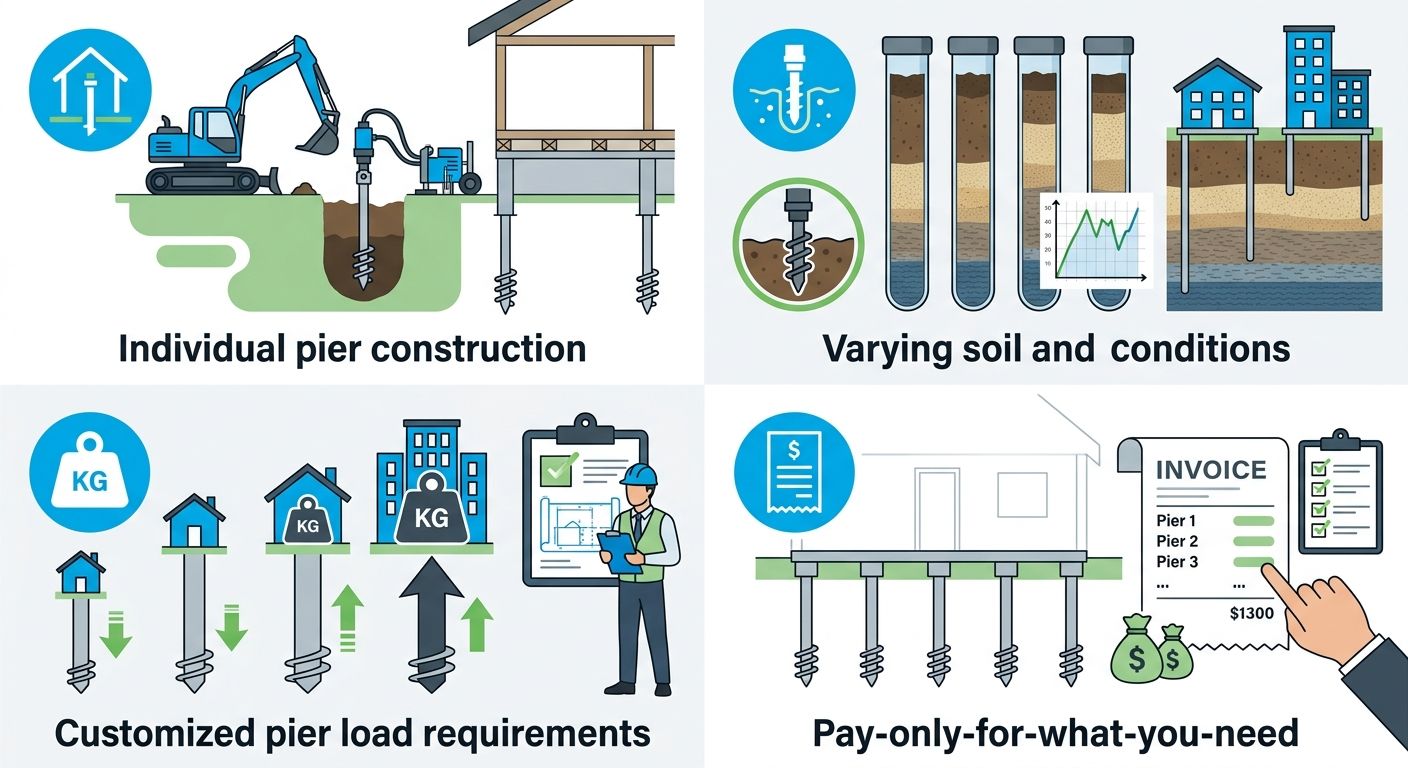
Four key reasons for per-pier pricing
Hidden Costs in Helical Pier Estimates
While the trending keyword ‘helical pier cost per pier’ seems straightforward, it typically reflects only materials and basic labor—not the full scope of a commercial deep-foundation project. Our team at ACN Construction has seen how these omissions can inflate final invoices by thousands of dollars. We believe every client in Centennial deserves a transparent, all-in estimate before the first rig arrives on site.
Several hidden charges can catch you off guard. Mobilization fees cover equipment transport and setup; these are rarely included in the base price per pier. Engineering design fees pay a structural engineer to size the piers and confirm placement, and they often surface as a separate line item on commercial jobs. Soil bearing capacity testing, local building permit fees, and third-party inspection costs round out the common “extras.” Commercial projects in Centennial frequently require deeper piers and formal load-testing reports, which push those ancillary fees higher.
Even for a smaller project like a garage door installation, hidden costs in helical pier estimates can appear if soil conditions require deeper piers. We advise every client to demand a detailed, line-item estimate that spells out whether mobilization, engineering, and inspections are bundled or charged separately.
Armed with knowledge of these hidden costs, you can compare quotes with confidence.
Request a Quote from ACN Construction for a fully transparent estimate. Let us help you get your project started.
Helical Piers vs. Concrete Piers
When comparing helical pier cost per pier to traditional concrete piers, the numbers tell an important story. Concrete requires additional excavation and curing time that adds to the overall project expense. According to the remodeling industry association, comparing foundation pier types is a critical step in any renovation project. Key factors to evaluate include installation time, soil suitability, load capacity, and best-use applications.
Helical Piers vs. Concrete Piers – Cost and Performance
The following table breaks down the essential differences between these two foundation solutions across the factors that matter most for Centennial homeowners.
| Factor | Helical Piers | Concrete Piers |
|---|---|---|
| Installation time | Same-day per pier | Multiple days (cure time) |
| Soil suitability | Excellent for clay/expansive | Good in stable soils |
| Load capacity | 50+ tons per pier | Varies; typically 20–30 tons |
| Best for | Retrofits, lightweight structures | New construction, heavy loads |
For Centennial properties built on expansive clay soils, the comparison strongly favors helical piers. These steel shafts transfer structural loads immediately without the drilling vibration that can disturb clay-rich ground, and they reach stable bearing strata well below the active moisture zone. Concrete piers, while cost-effective in stable soils, can shift and crack when clay expands and contracts through Colorado’s seasonal moisture cycles. Given these clear advantages in clay soils, helical piers emerge as the superior choice for Centennial projects. For a personalized recommendation tailored to your property’s soil conditions, contact our team today.
Helical Piers vs. Steel Push Piers
Now let’s compare both systems directly. The main difference lies in how each pier reaches load-bearing soil. Helical piers are screwed into the ground using a hydraulic torque motor much like a giant auger, while steel push piers are driven hydraulically into dense, compact earth. Because the installation method affects everything from equipment needs to soil compatibility, many Colorado property owners closely evaluate helical pier cost per pier before committing to a repair plan.
Helical Piers vs. Steel Push Piers – Cost and Performance
The following table breaks down the key differences between the two systems.
| Factor | Helical Piers | Steel Push Piers |
|---|---|---|
| Installation method | Screwed into ground | Driven/hydraulic push |
| Load capacity | 50+ tons per pier | 30–50 tons per pier |
| Soil compatibility | Clay, loam, sand | Dense, compact soils |
| Typical application | Retrofits, light commercial | Heavy residential/commercial |
Helical piers carry more weight per unit and perform reliably in Colorado’s widespread clay and loam soils, making them a strong choice for light commercial retrofits. When your project involves heavier residential structures over dense, compact ground, the lower helical pier cost per pier that steel push piers offer can provide a more economical path to stability. Before proceeding, verify your contractor’s credentials with the Colorado consumer protection agency. We are ready to help you select and install the system that best fits your site. Request a Quote to discuss your foundation repair needs, and let us help you get your project started.
When Depth Clauses Affect Total Cost
Beyond base material costs, the depth at which piers must be installed can dramatically alter the final price. When evaluating helical pier cost per pier, one of the biggest variables is the subsurface depth required to reach stable, load-bearing soil. Depth clauses in our contracts allow us to adjust pricing if unforeseen conditions demand deeper piers than originally estimated.
Each additional foot of depth increases material requirements—more steel shaft sections and additional helix plates—along with the labor and equipment time needed for installation. For instance, a pier initially scoped for 15 feet might need to extend to 25 feet because of unexpected clay or fill layers, triggering the depth clause and raising the total cost proportionally. Even for smaller foundation tasks like a garage door installation, depth clauses can apply if piers are needed to stabilize the slab.
Our helical piers adapt to depth changes more easily than concrete alternatives, but these adjustments still represent a direct cost increase. In commercial projects especially, variable soil profiles make depth clauses a standard safeguard. We recommend all clients review depth clause language carefully before signing to anticipate potential cost overruns. For a detailed estimate that accounts for depth clauses, request a quote from our team.
Foundation Repair Options Compared at a Glance
Now that we’ve covered each method individually, let’s compare them side by side. When considering helical pier cost per pier versus steel push piers, several factors—installation complexity, load requirements, and soil conditions—directly influence your decision. ACN Construction’s experience shows that choosing the right underpinning solution depends on your home’s specific structural needs.
As ACN Construction explains, helical piers are ideal for lighter structures and expansive soils, while steel push piers provide superior support when driven to stable bedrock. Both methods are proven underpinning solutions, but the right choice depends on soil composition and foundation weight.
We recommend professional evaluation before deciding. For best practices, consult the remodeling industry association guidelines and contact us for a personalized recommendation based on your soil conditions. Let us help you get your project started.
Making an Informed Decision on Helical Pier Cost Per Pier
When evaluating helical pier cost per pier, the cheapest quote often comes with hidden risks. We at ACN Construction believe the most cost-effective choice is the one that protects your home for decades, not just the lowest upfront number. We provide detailed, transparent breakdowns of pricing for helical piers so you can compare exactly what you are getting. Before you decide, consult the Colorado consumer protection agency to verify any contractor’s license and standing. Let us help you get your project started. Call us 24/7 or visit our website to Request a Quote for a free estimate and a customized plan that delivers lasting value.
Resources
- Contact ACN Construction for Garage Door Services
- Find ACN Construction Address and Operating Hours
- Discover Garage Door Installation Costs and Options
- Reach ACN Construction Via Phone and Email
- View ACN Construction Social Media and Contact Info
- Get ACN Construction Emergency Contact Information
- Explore ACN Construction Home Remodeling Services
- Find Certified Remodelers Through NARI Program
- Access DORA License Lookups and File Complaints