Historic Foundation Restoration: Essential Guide to Underpinning
Table of Contents
Historic Foundation Restoration Fundamentals
Historic foundation restoration requires a specialized approach because aging masonry, decades of settlement, and variable soil conditions create challenges that modern construction methods rarely address. We see these complexities across the Denver metro area, including Centennial, where expansive bentonite clays put continuous stress on older structures.
A common warning sign in historic masonry is stair-step cracks — diagonal separations that follow mortar joints and often signal differential foundation movement. Our team at ACN Construction has found that these patterns typically appear around door and window openings, which act as natural weak points when the ground shifts. Following preservation standards such as those published by the National Park Service official website ensures that any intervention respects the original construction while meeting modern structural expectations.
Modern stabilization techniques offer effective paths forward. Structural underpinning strengthens the existing foundation from below, while helical pier stabilization drives deep screw-like piers into load-bearing soil with minimal disruption to the historic structure. Both methods succeed only when a professional site assessment comes first — understanding the soil profile, crack patterns, and structural loads prevents misapplication. Never assume a crack is cosmetic simply because it is small. Let us help you get your project started: a thorough evaluation from an experienced design-build team makes the difference between a short-term patch and long-term stability.
Preparing for Historic Foundation Restoration
Once you have identified the condition of your historic foundation, the next step is preparing for historic foundation restoration. Start by carefully evaluating any stair-step cracks present. According to ACN Construction’s FAQ, these cracks often indicate settlement or expansive soil issues and should be monitored with crack gauges; if they widen to between one-eighth and one-quarter of an inch, professional assessment is necessary. Document the current foundation condition with photos and notes for reference, and clear the work area of furniture, belongings, and debris to provide unobstructed access. This also ensures the safety of the work crew, protects your valuables, and minimizes site disruption risks.
Next, schedule a site inspection with our team at ACN Construction. We will evaluate the root cause of the damage and determine whether structural underpinning or helical pier stabilization is appropriate for your historic foundation restoration. We also recommend checking with local permitting authorities in Centennial, CO to see if a permit is required, and submitting applications early so that the project stays on schedule.
With the site ready and the plan in place, the restoration process can begin.
Assessing the Condition of an Old Foundation
In historic foundation restoration, evaluating an old foundation’s condition is the critical first step. According to ACN Construction, stair-step cracks wider than 1/4 inch often indicate structural problems needing expert inspection. For a definitive evaluation, contact a licensed contractor and verify licensure through DORA.
Instructions
- Measure any visible cracks with a crack monitor or ruler. Cracks wider than 1/4 inch often warrant professional evaluation.
- Look for stair-step cracks that follow mortar joints in a diagonal pattern, as opposed to minor hairline fissures.
- Probe the soil around the foundation with a rod to check for erosion, soft spots, or poor drainage.
- Test interior doors and windows for binding, which suggests foundation movement.
Why It Matters
Proper assessment avoids misdiagnosis and directs you to effective repairs. Skipping this step can allow underlying issues to escalate, leading to higher costs and safety concerns.
Tips
Use a crack monitor to track growth; consult a pro if the gap widens. Watch for misaligned doors and trim. For multiple symptoms, have a contractor inspect.
Once you understand the foundation’s condition, the next section, Repair Options for an Old Foundation, covers solutions including structural underpinning and helical pier stabilization.
Choosing Stabilization Methods for Old Foundations
Instructions
Historic foundation restoration requires careful evaluation of masonry and soil conditions. Structural underpinning reinforces footings with added concrete or steel. Helical piers are deep screw-like anchors that reach stable soil. Mortar repair repoints surface-level mortar damage.
The right stabilization method depends on foundation material and soil capacity. In expansive soils, helical pier stabilization uses deep foundation systems like Hubbell’s to anchor into load-bearing strata. We recommend an engineer evaluation and soil testing before proceeding.
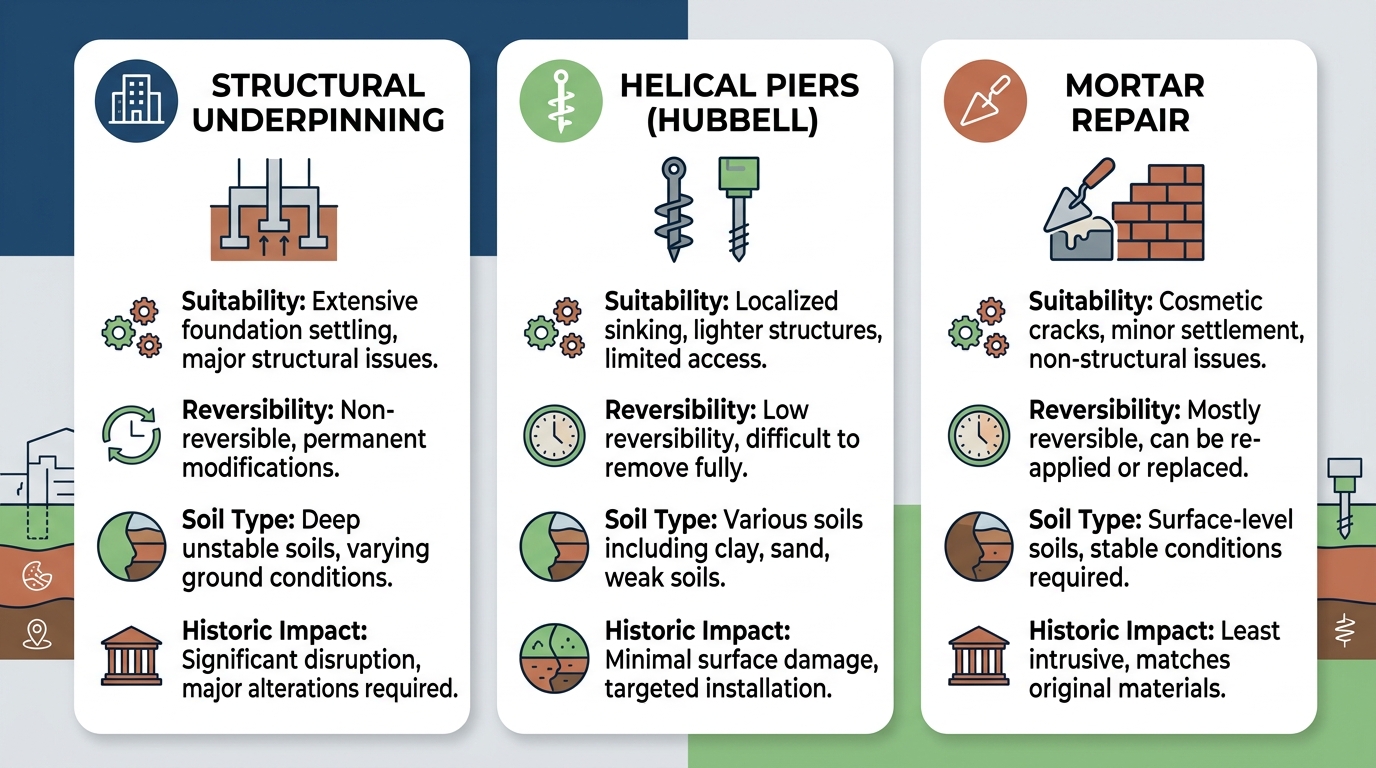
Foundation stabilization methods: underpinning, helical piers, and mortar repair comparison.
This comparison highlights how each technique works.
Why It Matters
Choosing the correct method maintains structural integrity while preserving the building’s historic fabric. Historic foundation restoration using an inappropriate technique can irreparably damage original materials and fail to correct soil issues. Preserving authenticity and safety demands a method matched to the specific conditions. The long-term stability of the entire structure depends on this informed choice.
Tips
Always consult a structural engineer with proven experience in historic buildings. Perform a soil bearing capacity test before finalizing any stabilization plan. These steps prevent costly mistakes and ensure the selected method aligns with site-specific conditions. If you’re ready to evaluate your historic foundation, let us help you get your project started.
Preparing the Foundation Site for Restoration
Instructions
After assessing stair-step cracks and foundation damage, proper site preparation is essential before any historic foundation restoration in Centennial.
We excavate around the foundation to the full depth of damage, maintaining a safe slope or using shoring for deep digs. We protect landscaping, adjacent structures, and utility lines before breaking ground, and set up temporary drainage control to prevent water accumulation.
We mark utility lines and obtain required permits, then photograph all pre-existing conditions—crack patterns and soil settlement—for reference.
Why It Matters
Proper site prep prevents unintended damage and keeps our team safe. Documenting existing conditions reveals underlying causes like stair-step cracking from soil movement, giving us a clear baseline for restoration.
With stable access and drainage control, we can work efficiently and avoid costly delays.
Tips
Use shoring for deeper excavations; photograph crack patterns before covering them. Manage water away from the site.
For deep stability concerns, structural underpinning or helical pier stabilization may be required. Estimates are preliminary and subject to change after site inspection and full scope review.
With the site properly prepared, we can then proceed with the actual restoration steps, including underpinning and crack repair, covered in the next section.
Installing Helical Piers for Structural Support
Installing helical piers requires a precise process to ensure stable load transfer. We follow these steps:
Instructions
- Position the helical pier at the chosen location.
- Use a hydraulic drive head to rotate the pier while torque monitoring — recorded as a proxy for load-bearing capacity — and continue until reaching the target value specified by the manufacturer, such as a Hubbell electrical and utility products helical pier system.
- Conduct a load test (compression or tension) to verify design capacity.
- Mechanically attach the pier to the existing foundation via a bracket assembly.
This transfers structural loads directly to deeper, stable soil without stressing the original masonry.
Why It Matters
Helical pier stabilization is ideal for historic foundation restoration because it transfers loads to competent soil, bypassing deteriorated masonry. This structural underpinning method preserves the original fabric while delivering reliable support.
Tips
We recommend hiring a contractor experienced with helical piers on historic structures. Verify that all torque values are documented and meet the engineered design. At ACN Construction in Centennial, CO, we provide this precise installation, ensuring long-term performance and simplifying future inspection and maintenance.
Repairing Mortar Deterioration in Stone Foundations
Instructions
Mortar deterioration in stone foundations is a key concern in historic foundation restoration. To repair it, start by removing deteriorated mortar with hand tools to protect the stone. The National Park Service recommends a lime mortar that is softer than the stone. Mix to match historical composition, dampen joints, pack mortar in thin lifts, and tool when thumbprint-hard.
Why It Matters
Hard Portland cement mortars trap moisture and crack stone. The National Park Service advises that mortar must be sacrificial — eroding before the stone. Proper repointing allows the foundation to breathe, preventing spalling and preserving structural integrity.
Tips
Match the original mortar’s color and texture. Avoid Portland cement-heavy mixes on soft stone, as our team ensures on every project. For more serious issues like structural underpinning or helical pier stabilization, refer to our later sections on foundation repair methods. These best practices safeguard your home’s historic character.
Meeting Code Requirements for Historic Foundation Repairs
Instructions
Historic foundation restoration in Centennial involves specialized techniques but also strict code requirements. According to the International Code Council (ICC) and its model International Code Council building codes, historic structures must meet both current codes and local historic preservation rules — adding extra review layers. Non-compliance can stop work and lower property value. We recommend working with a contractor familiar with the local historic preservation office and permitting process in Centennial and the Denver metro area. Proper permits, scheduled inspections, and documentation are essential before any historic foundation work.
Why It Matters
Local historic designations impose additional compliance layers that complicate historic foundation repairs. Non-compliance can halt your project, result in fines, and reduce property value. Permit, inspection, and fee requirements vary by jurisdiction and may affect schedule and cost.
Tips
Work with a contractor experienced in historic foundation restoration in Centennial. Our team can help guide you through the process, from navigating the historic preservation office to applying ICC guidelines for existing structures. For definitive requirements before structural underpinning, consult your local building department and a licensed contractor.
Preserving Historic Home Value During Restoration
Instructions
Unlike modern foundation work, historic foundation restoration requires reversible methods and material integrity. Start by assessing structural elements and consulting a preservation specialist. We advocate minimal intervention: use helical pier stabilization (screw piles) installed without disrupting historic masonry. The National Park Service recommends matching existing materials and documenting features before changes. Retain original materials whenever possible; structural underpinning must be reversible. This approach preserves authenticity and protects your investment.
Why It Matters
Inappropriate repairs can permanently devalue a historic home. Using mismatched materials or irreversible foundation fixes damages authenticity; sensitive restoration maintains, and often enhances, property value and market appeal. Historic designation standards frequently require reversible methods; noncompliance can reduce saleability.
Tips
When in doubt, retain original materials and seek a preservation consultant’s advice before visible alterations. Monitor stair-step cracks carefully; widening or active cracks may signal foundation issues. For tailored historic foundation restoration strategies, contact us: let us help you get your project started. Always consult a licensed preservation specialist.
Overcoming Common Challenges in Historic Foundation Restoration
Historic foundation restoration presents challenges that differ sharply from modern construction. Century-old footings, fieldstone masonry, and outdated drainage systems can mask settlement and deterioration until visible warning signs appear. We know from experience in Centennial, CO that identifying these signs early makes the difference between targeted stabilization and a complete foundation rebuild.
One of the clearest indicators of structural movement in older homes is stair-step cracks in brick or block foundation walls. Our internal FAQ on stair-step cracks explains that while hairline cracks can be cosmetic, a stair-step pattern passing through both mortar and masonry units often signals differential settlement or excessive lateral pressure. Cracks wider than 1/8 inch, active growth, and side effects like sticking doors warrant immediate professional evaluation, a standard we apply to every historic foundation assessment.
When footings have settled or lost load-bearing capacity, structural underpinning transfers the weight of the structure to competent soil or bedrock. This method reinforces shallow or deteriorating foundations by extending them deeper, and it aligns with the guidance we provide in our foundation FAQ. Before undertaking any underpinning, however, we ensure the planned work complies with the International Building Code as adopted locally in Centennial, CO, and we coordinate with local permitting authorities to avoid code conflicts.
For historic structures where minimal excavation is critical, helical pier stabilization offers a low-vibration alternative. Helical piers are screwed into stable soil beneath the active movement zone, lifting and stabilizing the foundation without the need for heavy machinery that might disturb fragile masonry. Our team has deep experience with helical pier foundations, and we’ve used them successfully on older homes throughout Centennial, CO.
Every historic foundation is unique, so a custom on-site assessment is the only reliable way to determine the right course of action. We bring design-build single-point accountability to each project, from initial inspection through engineering and installation, ensuring every step adheres to current building code requirements. If you own an older home and are considering historic foundation restoration in Centennial, CO, reach out to us for a thorough, no-obligation evaluation.
Securing Your Historic Home for Generations to Come
Historic homes in Centennial, Colorado, feature charming architecture, but aging foundations may need historic foundation restoration to remain safe. One common problem we address across Centennial is stair-step cracks in brick or stone, often caused by foundation settlement.
When we provide foundation restoration for historic homes, we use structural underpinning to shift loads to deeper stable soil and helical pier stabilization to gently lift and support settled sections. These methods can permanently stabilize the foundation. Early intervention not only stops ongoing settlement but also preserves your home’s historic appeal for generations to come.
Given Centennial’s expansive soils, a professional evaluation by a contractor who understands Colorado building codes is essential before any work starts. As a design-build firm in Centennial, we handle everything from initial assessment to final permitting, giving you a single point of accountability. We invite you to request a custom quote—let us help you get your project started with a thorough assessment. In the next section, we’ll explain the specific process ACN Construction follows, from diagnostics through helical pier installation.
Resources