Smart Home Basement Integration Trends: Key Insights for 2026
Table of Contents
- Smart Home Basement Integration Trends in 2026
- Plan Your Smart Basement Integration Project
- Choose Essential Smart Technology for Finished Basements
- Install Smart Water Detection in Remodeled Basements
- Set Up a Reliable Mesh Network for Basement Floor Plans
- Design Smart Lighting Zones for Basement Media Rooms
Smart Home Basement Integration Trends in 2026
Homeowners across the country are embracing smart technology, and basement remodels in 2026 are reflecting this shift with advanced, connected features. According to the National Association of Home Builders (NAHB), energy efficiency and automated climate management remain top priorities for new home designs, a trend that seamlessly translates to basement finishing. These “smart home basement integration trends” emphasize creating a connected ecosystem underground, where lighting, security, and entertainment are controlled from a single device.
Popular features we see gaining traction include voice-activated lighting zones for a home theater, automated shades for daylight basement windows, and integrated multi-room audio systems. Smart thermostats and moisture sensors are also critical, helping to manage the unique climate conditions of a below-grade space while supporting sustainable energy use. Future-proofing with structured wiring and dedicated IoT networks ensures these systems perform reliably.
For homeowners considering a south Denver basement remodeling project, integrating these smart features can significantly enhance the space’s comfort and value. As a design-build firm, we help clients plan for these technologies from the very first concept, ensuring your finished basement is not only beautiful but intelligently connected. Let us help you get your project started.
Plan Your Smart Basement Integration Project
Following the latest smart home basement integration trends ensures your remodel adds lasting value, and a thoughtful smart home setup in the basement elevates everyday living. Here’s how to get started with a solid plan.
- Define your smart home goals. Decide which features matter most—energy-efficient lighting, integrated security, or immersive entertainment—so your design stays focused.
- Evaluate your basement’s existing conditions. Check for adequate wiring, moisture levels, and insulation. Addressing these infrastructure points early prevents costly rework later.
- Allocate your budget. Plan to split funds between the foundational construction work and the smart technology components. A realistic budget balances structural integrity with the desired automation, and we can help you estimate a fair range once we assess your basement. We also recommend setting aside a contingency fund of 15–20% to cover unexpected issues common in older basements.
- Choose a contractor with smart home expertise. Verify your contractor’s license through DORA, ask for references from past smart integrations, and request a site inspection before finalizing plans. A design-build firm like ACN Construction provides single-point accountability, which simplifies the coordination of construction and intelligent basement technology components. Our own guidelines for selecting renovation contractors emphasize checking credentials, verifying licensure, and reviewing past smart home projects.
Once your plan is solid, we’ll move to designing the ideal smart layout that blends technology seamlessly with your living space. Our design-build approach keeps you in the loop from start to finish. If your smart basement is part of a whole home remodel in Centennial, coordinating all phases under one contract simplifies the process and minimizes delays. Because every basement has unique conditions, timelines naturally vary—we’ll help you build a realistic schedule based on your site inspection. Let us help you get your project started.
Choose Essential Smart Technology for Finished Basements
Smart home basement integration trends in the Centennial and Denver area are reshaping how families enjoy their finished basements. Our design-build team sees increasing demand for connected lighting, climate control, and entertainment systems that add both comfort and value. Integrating these features early in the remodel ensures seamless operation and avoids disruptive retrofits later. As a design-build firm, we plan these integrations from the start, so you avoid costly retrofits later.
We follow NARI best practices for smart home technology integration, planning each system carefully. Key smart technologies—programmable lighting, smart thermostats for zoned comfort, integrated security, and entertainment systems—are all popular. Lighting scenes and dimmable controls set the mood. We recommend selecting devices that work with your existing ecosystem and can expand as your needs change. Voice assistants like Amazon Alexa and Google Assistant tie these systems together, giving you intuitive control across your basement.
We recommend evaluating compatibility and needs, as smart home basement integration trends point toward voice control and zoned comfort; rough-in wiring ensures future adaptability.
Install Smart Water Detection in Remodeled Basements
As smart home basement integration trends reshape lower-level transformations, adding water detection sensors has become a critical upgrade. These devices provide early warning against leaks, protecting newly finished walls, flooring, and furnishings from costly water damage. Tied into existing smart home systems, they send instant alerts to your phone, giving you peace of mind whether you’re at home or away.
Proper placement near water heaters, sump pumps, and plumbing fixtures ensures comprehensive coverage. Sensors can trigger automatic shutoff valves in some setups, reducing the risk of extensive water intrusion before help arrives. By integrating these sensors during your basement remodel, our team can conceal wiring and ensure seamless connectivity with your whole-home automation system. We focus on risk reduction rather than absolute prevention, helping you safeguard your investment. Regular monitoring and instant notifications give you confidence that your finished basement remains protected around the clock.
We recommend working with licensed professionals for proper system integration. The Plumbing Heating Cooling Contractors of Colorado (PHCC) verifies contractor credentials; find qualified plumbing heating cooling contractors in Colorado through their directory. When you work with us, we coordinate the entire remodel and integrate smart upgrades seamlessly. Let us help you get your project started — contact our team to discuss integrating smart water detection into your basement remodel.
Set Up a Reliable Mesh Network for Basement Floor Plans
Once you understand the trends shaping modern basements, the next step is ensuring reliable connectivity—starting with a mesh network designed for smart home basement integration trends. Basements in the Centennial area present unique challenges because concrete walls and below-grade construction can seriously degrade traditional router signals. We recommend a mesh system rather than a single router, placing at least one node centrally in the basement and additional nodes on upper floors to create seamless, whole-home coverage.
According to National Association of Home Builders research on smart home technology adoption, modern basements increasingly serve as media rooms, home offices, or guest suites that demand strong Wi-Fi. For the most reliable throughput—especially for cameras, thermostats, and speakers—we advise using wired backhaul between nodes through MoCA or Cat6 runs. Planning these connections during basement remodeling, including low-voltage conduit or Ethernet drops to planned node locations, prevents costly retrofits later. Let us help you integrate structured cabling and node placement into your design-build basement plan so your connected living space performs exactly as you expect.
Design Smart Lighting Zones for Basement Media Rooms
Smart lighting zones are essential for basement media rooms that balance immersive entertainment with everyday living. As smart home basement integration trends gain traction, homeowners want zoned control that sets the perfect scene without disruption.
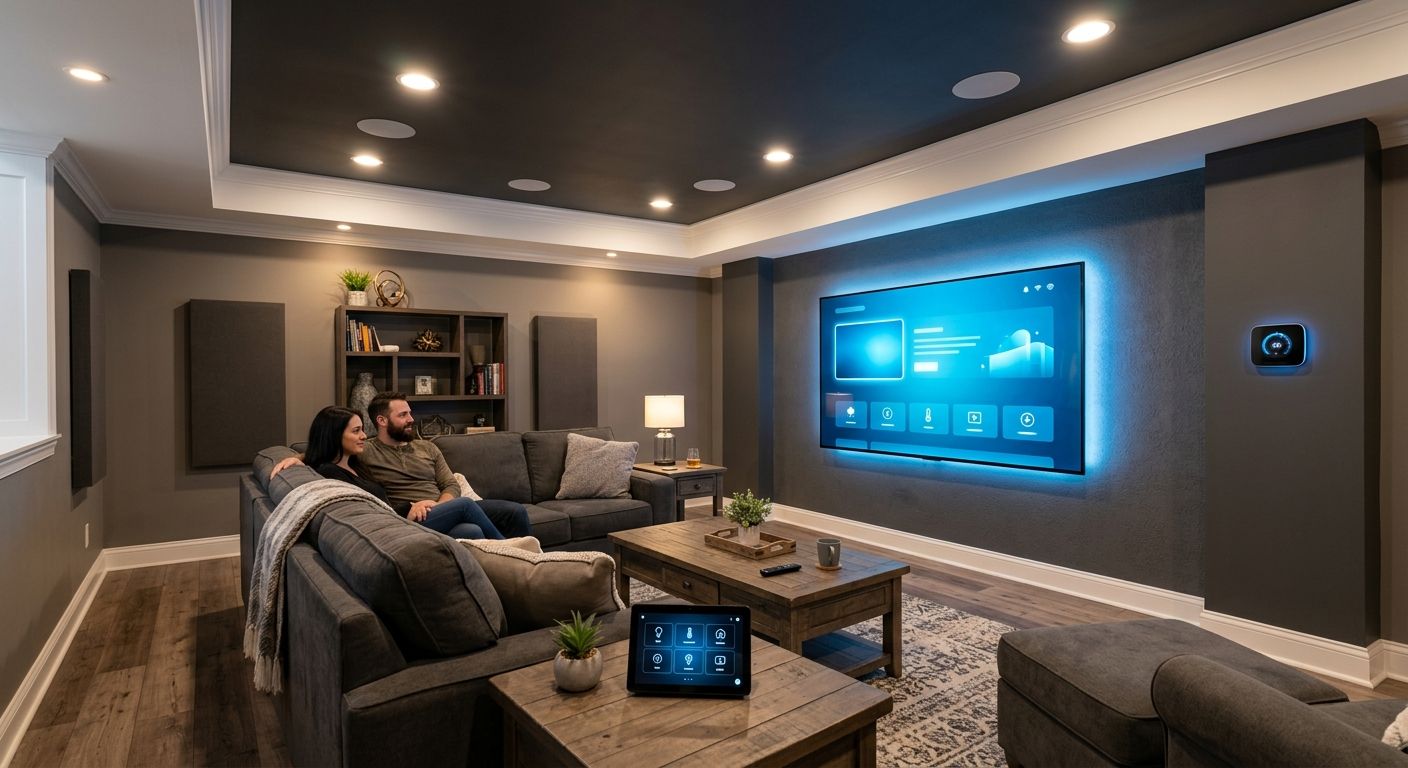
A media viewing zone relies on bias lighting behind the screen—we often use LED strips—paired with dimmable recessed cans overhead to reduce eye strain. Ambient pathways use soft, indirect light for safe ingress, while accent lights on shelving highlight decor or media. Voice- or app-controlled smart dimmers make automated dimming and zoned lighting control effortless, aligning with broader smart home basement integration trends. Because basements lack natural light, tunable white bulbs that simulate daylight cycles—a biophilic design approach—not only improve comfort but also add measurable property value.

Smart lighting zones for basement media rooms
ACN Construction can integrate these zone designs during your basement remodel in Centennial, CO, applying biophilic design to boost comfort and property value.
Implement Smart Humidity Control to Protect Basement Walls
Emerging smart home basement integration trends emphasize automated humidity management as a critical defense for basement walls. In Colorado, where semi-arid conditions can still bring heavy rain, demand-based moisture control can significantly reduce moisture risks, safeguarding structural integrity and indoor air quality.
As part of our sustainable home remodeling in Colorado, we integrate smart sensors—like Wi-Fi hygrometers that work with HomeKit or SmartThings—to trigger dehumidifiers and exhaust fans whenever relative humidity exceeds 60%. Pairing automated dehumidification with a sump pump or French drain ensures thorough moisture removal, while vapor-permeable coatings such as Drylok Extreme allow walls to breathe without trapping water. These smart home basement integration trends deliver healthier, longer-lasting walls when implemented correctly. By aligning these technologies with local climate demands, our Design Build Services create a comprehensive, eco-friendly basement package. Let us help you get your project started.
Integrate Smart Devices with a Central Home Hub
As smart home basement integration trends continue to evolve, a well-planned remodel in a Centennial basement presents the perfect opportunity to bring all your devices under one roof with a central smart hub. We help homeowners move beyond piecemeal setups by designing a system where lighting, security, and entertainment respond together. A central hub like Samsung SmartThings or Hubitat, which uses Z-Wave and Zigbee protocols, can provide reliable control even in basement environments where Wi-Fi range is often limited.
During a whole-home transformation, our design-build team can run low-voltage wiring and structured cabling to connect smart LED lighting, programmable thermostats, security cameras, door sensors, and multi-room audio speakers. This approach allows you to control every device through a single app or via voice commands with Amazon Alexa and Google Assistant, turning your basement into a unified automation hub.
By planning hub placement and wiring routes early, we help you avoid messy retrofits and create a wellness sanctuary where scenes like “Movie Mode” automatically dim the lights and lower the blinds. Intelligent integration can also increase home value and appeal to eco-conscious buyers in the Denver and Centennial market. Let us help you get your project started.
Test and Calibrate Your Smart Basement System
Once your smart basement system is installed, testing and calibrating each component is the next critical step. As smart home basement integration trends advance, proper setup of sensors and controls protects your investment and helps prevent false alerts. Start by verifying sump pump sensors, humidity and temperature sensors, motion detectors, smart lighting, and automated ventilation. For water sensors, perform a zero-point calibration; adjust humidity triggers to your preferred threshold; and program lighting schedules around your daily routines. These steps ensure each device reacts accurately without unnecessary triggers.
For systems that link multiple smart devices, we recommend working with a professional contractor. As we advise in our guide to selecting renovation contractors, ACN Construction’s team has the expertise to calibrate integrated systems, minimizing the risk of false alarms or device conflicts. We suggest a testing schedule: immediately after installation, monthly for the first quarter, and quarterly thereafter to maintain reliability. After calibration, regular maintenance and periodic checks will keep your smart basement performing optimally.
Troubleshoot Common Smart Home Basement Issues
While the possibilities of smart home basement integration trends are exciting, homeowners in the Centennial and Denver metro area often encounter a few common hurdles. Basement conditions present unique challenges for connected devices, but proactive planning can keep your project on track.
Thick concrete walls and below-grade dampness frequently weaken Wi-Fi signals, creating dead zones for smart hubs and sensors. We have found that mesh network systems or Powerline adapters that use existing electrical wiring can reliably extend coverage to every corner of a finished basement. Planning your network layout before drywall installation ensures the strongest possible signal for all your connected home basement setups.
Renovation timelines for smart basements can also face setbacks from permitting and material delays. According to our experience at ACN Construction, building permit approvals in Centennial typically take four to eight weeks, and long-lead smart devices should be ordered months in advance to avoid stoppages. Older Denver-area homes often require electrical panel upgrades to safely handle the load of modern IoT devices, a hidden cost that can range from $3,000 to $6,000. For a seamless integration of smart basement technology, we advise consulting a professional with dual expertise in remodeling and connected systems. You can find certified experts through the professional remodeling association directory.
Protecting your investment from moisture is equally critical. We recommend placing smart plugs, sensors, and hubs away from sump pumps and plumbing rough-ins, or using moisture-proof enclosures for added security. A site inspection by a licensed contractor can identify the best device placement and necessary safeguards for your specific space.
If these issues persist, a professional assessment can save time and money by ensuring every element is correctly specified and installed. Let us help you get your project started.
Build a Future-Ready Smart Basement with Professional Guidance
Smart home basement integration trends are transforming how homeowners in Centennial maximize their lower levels, blending convenience with integrated technology. A future-ready design now commonly includes automated lighting, climate control, security, and entertainment systems—each demanding careful planning and precise execution. As a design-build firm offering Design Build Services, ACN Construction provides single-point accountability for complete remodeling, coordinating all trades from permits to final finishes. Through our whole home remodel in Centennial and basement remodeling in South Denver, we have refined the expertise to wire, code, and integrate smart features seamlessly. By following guidelines from the home building industry association, we ensure your infrastructure is built to the latest standards. We stay ahead of emerging trends, recommending conduit runs and structured panels that keep your basement adaptable for years to come. We also consider local environmental factors such as radon mitigation and expansive soils, ensuring your smart basement remains safe and durable. Professional guidance avoids mistakes like insufficient electrical capacity, saving you time and expense. Let us help you get your project started.
Resources