ADU Regulations Colorado 2026: Complete Guide to HB24-1152
Table of Contents
- Understanding ADU Regulations in Colorado for 2026
- Key Colorado ADU Laws and HB24-1152 Implementation
- Denver Metro ADU Development Codes and Compliance
- Practical Steps for Planning and Permitting Your ADU
- Advanced Considerations for Custom ADU Design
- Frequently Asked Questions About ADU Regulations
- Start Your ADU Project with ACN Construction
Understanding ADU Regulations in Colorado for 2026
Looking ahead to 2026, Colorado homeowners will face a new regulatory landscape shaped by evolving ADU regulations Colorado 2026. The state’s approach to accessory dwelling units is shifting, with new laws encouraging development while leaving significant authority in the hands of local governments. We want to help you understand these changes so you can plan confidently.
The cornerstone of this shift is Colorado HB24-1152 implementation mandates, which require many municipalities to allow ADUs in single-family zones by 2026. However, this state law does not override stricter local codes. In the Denver Metro area, jurisdictions maintain their own Denver metro ADU development codes that govern everything from lot size and setbacks to height limits, parking, and owner-occupancy requirements. According to the City and County of Denver, official regulations and updates are available on their website, which remains the authoritative source for city-specific rules.
For homeowners, this layered regulatory environment has practical implications. Permitting timelines, fee structures, and inspection requirements vary by jurisdiction and are subject to change. We recommend starting early to allow for site inspection, scope review, and permit lead times. Please note that this information is for educational purposes only and does not constitute legal or permitting advice; consult a licensed contractor and verify licensure with the Colorado Department of Regulatory Agencies (DORA) for definitive guidance.
Understanding these statewide ADU rules is the first step toward a successful project. Partnering with a design build service like ACN Construction ensures you have a single point of accountability for navigating both design and compliance. We bring hands-on regulatory knowledge to every project, helping you move smoothly through the approval process while keeping your vision on track.
Key Colorado ADU Laws and HB24-1152 Implementation
To build an ADU in Colorado, it’s essential to understand the state and local laws that govern them. With new adu regulations colorado 2026 taking shape, homeowners across the state are seeing a major shift in what’s allowed on residential properties.
Understanding HB24-1152 and Its Timeline
Signed into law in 2024, HB24-1152 marks a significant change for accessory dwelling units in Colorado. The legislation requires all municipalities to allow ADUs in residential zones, with larger cities needing to comply by 2025 and remaining jurisdictions by 2026. The colorado hb24-1152 implementation mandates ensure that no city can prohibit ADUs outright, although local governments retain authority over design standards, size limits, and other zoning details.
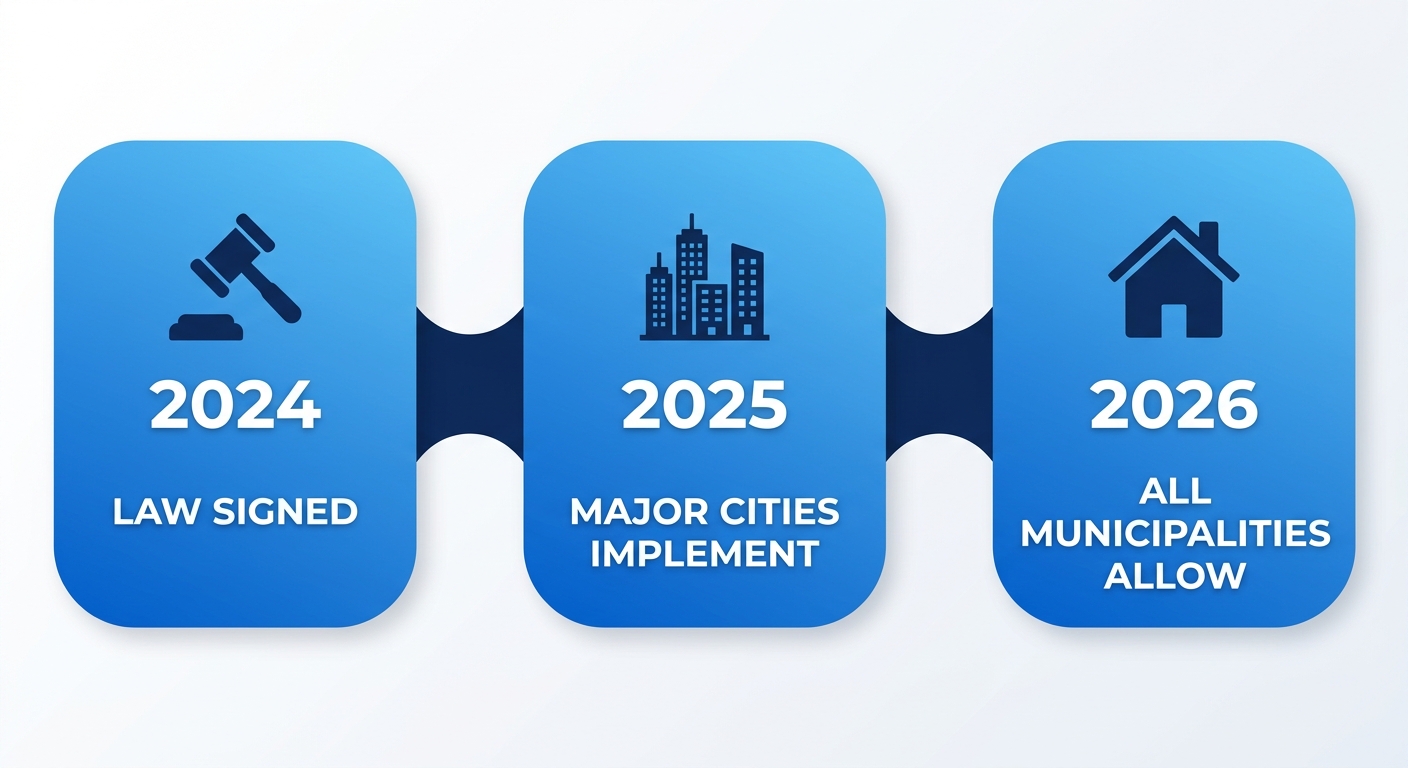
Colorado HB24-1152 ADU implementation timeline visualization
In practice, this means homeowners interested in adding an ADU will encounter a framework where state law opens the door, but local rules still shape the details. The Colorado Department of Regulatory Agencies (DORA) oversees contractor licensure, and we coordinate closely with local planning departments to navigate these layered requirements.
Navigating Denver Metro ADU Development Codes
The denver metro adu development codes add another layer of regulation on top of the state mandate. Many cities in the Denver area, including Denver itself, already had ADU ordinances in place before HB24-1152. According to the City and County of Denver, local provisions may address setbacks, height limits, parking requirements, and owner-occupancy rules that go beyond what the state law dictates.
Because implementation varies by jurisdiction, homeowners should verify current codes with their local planning department. The City and County of Denver provides official zoning and permit information that reflects the most up-to-date requirements. Our team has experience working within these municipal frameworks, ensuring that design-build projects align with both state mandates and city-specific codes.
Practical Takeaways and Next Steps
Understanding the adu regulations colorado 2026 timeline helps homeowners plan confidently. Here are a few key points to keep in mind:
- HB24-1152 prohibits outright ADU bans but does not override local zoning details
- Deadlines fall in 2025 for larger cities and 2026 for all other municipalities
- Denver metro codes may include additional requirements for setbacks, height, parking, or owner occupancy
- Checking with your local planning department remains essential before starting any project
We recommend consulting your municipality’s current zoning codes before finalizing ADU plans. Once you understand the legal framework, the next step is the permitting and zoning process specific to your municipality. Please consult a licensed contractor or your local planning department for definitive advice on your specific project. Let us help you get your project started.
Denver Metro ADU Development Codes and Compliance
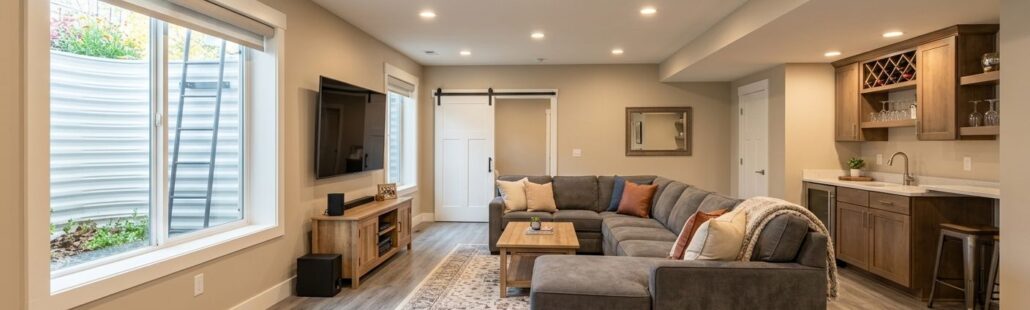
For homeowners researching ADU regulations in Colorado for 2026, the Denver Metro area has specific zoning and code requirements you need to know. As a leading design-build firm in Centennial, we help clients navigate these Denver Metro ADU development codes so their accessory dwelling unit meets every legal standard. The table below summarizes the key differences between a finished basement and a legal ADU—critical distinctions every homeowner must understand before planning a conversion.
| Requirement | Finished Basement | Legal ADU |
|---|---|---|
| Permitting | Often none (if no changes to egress/mechanical) | Required – building, electrical, plumbing, mechanical |
| Egress | Existing window may suffice | Must meet ICC code (min. 5.7 ft² opening) |
| Ceiling Height | 7 ft typical (may vary) | 7.5 ft minimum for habitable rooms |
| Utilities | Shared with main house | Separate metering often required |
| Use as Rental | Not allowed – no separate dwelling status | Allowed – qualifies as separate dwelling |
Code references based on Denver Zoning Code and the 2021 IRC as adopted by Denver. Data sources include Denvergov.org and Colorado HB24‑1152 text. Requirements may vary by jurisdiction; consult your local building department. Permit, inspection, and fee requirements vary by jurisdiction and may affect schedule and cost.
Zoning and Permitting Requirements in Denver Metro
Denver’s zoning code establishes distinct rules for detached, attached, and garage‑conversion ADUs. Detached units typically require five‑foot side setbacks and are capped at 24 feet in height for a one‑story structure, though corner lots and overlay districts may impose tighter limits. The permit pathway demands a building permit, electrical permit, plumbing permit, and mechanical permit, all obtained from Denver Community Planning and Development or the applicable metro jurisdiction.
Colorado HB24‑1152 implementation mandates, effective in 2025, relax owner‑occupancy requirements and reduce minimum lot sizes for ADUs across much of the state. However, jurisdictions like Centennial, Aurora, and Littleton may have local overlays that differ—encourage readers to verify with the specific city planning office. Homeowners considering a detached ADU can leverage the same design‑build approach used for custom home construction, ensuring every permit and inspection is coordinated from day one. Always verify current requirements with the Denver building department.
Separate Utility Metering and Code Compliance
When an ADU will be rented as a separate dwelling unit, Denver Water and Xcel Energy service rules mandate separate electric, water, and gas meters. This ensures each unit can be billed independently and simplifies compliance with local utility regulations. Fire‑separation requirements between the main house and the ADU are enforced under the 2021 IRC, typically calling for a one‑hour fire‑rated wall assembly when the units share a common wall or ceiling.
Egress is equally critical. Every sleeping room must include an egress window with a net clear opening of at least 5.7 square feet, a minimum width of 20 inches, and a minimum height of 24 inches to satisfy life‑safety code. For basement ADUs, window wells may be required to maintain that clearance. Our design‑build team coordinates with electrical, plumbing, and mechanical inspectors so that every code checkpoint is addressed before drywall goes up. Always verify current requirements with the Denver building department.
Design Considerations for Legal ADU Status
Beyond zoning and utilities, the physical dimensions and materials of the space determine whether it qualifies as a legal ADU. The 2021 IRC requires a minimum ceiling height of 7.5 feet for habitable rooms and 7 feet for bathrooms and hallways, which often rules out older basements finished with drop ceilings. Insulation values must meet the 2021 IRC Energy Code for basements, including R‑15 continuous insulation on exterior walls; a finished basement lacking those upgrades cannot be converted to an ADU without stripping and re‑insulating walls.
Soundproofing between the primary residence and the ADU is another practical design element that code officials and occupants both appreciate. Proper window sizing, adequately rated assemblies, and continuous air barriers all contribute to a comfortable, code‑compliant dwelling. Meeting these requirements is easier when you work with a team that knows Denver’s ADU codes inside and out. Please consult a licensed contractor for definitive advice; verify licensure with the Colorado Department of Regulatory Agencies (DORA). With the code framework in place, the next logical question is how to budget your ADU project.
Practical Steps for Planning and Permitting Your ADU
Now that you understand the basics of ADUs and how ADU regulations Colorado 2026 are shaping the landscape across Colorado, let’s walk through the practical steps. Whether you’re considering a basement conversion or a detached unit, navigating the planning and permitting process in Denver Metro requires understanding both state-level mandates and local development codes. At ACN Construction, we guide homeowners through every phase so your project stays on track and meets all compliance requirements.
Steps to Convert a Basement into a Legal ADU
Converting a basement into a legal ADU involves a clear sequence of steps that help you move from concept to completion efficiently. As 2026 Colorado ADU rules take effect, verifying local zoning is critical before any work begins.
- Feasibility Assessment: We evaluate your existing basement for ceiling height, separate entrance potential, and natural light requirements per Denver Metro ADU development codes.
- Design and Planning: Our team creates plans that address egress windows, fire separation, ventilation, and kitchen/bathroom layouts.
- Permitting: Permitting now reflects Colorado HB24-1152 implementation mandates, so we coordinate directly with your local jurisdiction, whether Denver, Centennial, or surrounding communities.
- Construction: Licensed subcontractors execute framing, electrical, plumbing, and finishes under our on-site project manager’s supervision.
- Final Inspection: We schedule all required inspections to verify code compliance before you receive the certificate of occupancy.
Once you understand the steps, the next question is cost. Let’s examine the factors that influence your ADU budget.
Cost Factors and Budgeting for Your ADU
Understanding what drives ADU costs helps you plan a realistic budget. While every project is unique, several consistent factors shape the final investment — from square footage to permit fees. Estimates are preliminary and subject to change after site inspection and a full scope review.
- Size: Larger ADUs require more materials and labor, directly impacting cost.
- Finishes: High-end selections like custom cabinetry and stone countertops increase the budget compared to standard-grade finishes.
- Utility Separation: Adding independent plumbing, HVAC, and electrical service lines involves additional work scope.
- Soft Costs: Permits, engineering reports, and legal fees vary by municipality; permit, inspection, and fee requirements vary by jurisdiction and may affect schedule and cost.
Because these variables differ from one property to the next, we recommend requesting a custom quote tailored to your specific basement or garage conversion. Please consult a licensed contractor for definitive advice; verify licensure with the Colorado Department of Regulatory Agencies (DORA). Let us help you get your project started.
A design-build contractor can simplify both planning and execution. Here’s how our approach streamlines the entire ADU process.
Working with a Design-Build Contractor for ADU Projects
Traditional construction often fragments responsibility across separate designers, engineers, and builders, leading to miscommunication and delays. Our design-build model provides single-point accountability, meaning we manage every phase — from initial concept through final finishes — under one contract.
- Streamlined Approvals: We understand Denver Metro development codes and Colorado HB24-1152 implementation mandates, helping your project move through permitting efficiently.
- Coordinated Trades: Our on-site project manager schedules and supervises all subcontractors, reducing gaps in the construction timeline.
- Quality Control and Warranty: We stand behind our work with a comprehensive warranty. Project outcomes and timelines may vary based on site conditions, permitting, material availability, and unforeseen issues, but our process minimizes surprises.
When you work with ACN Construction, you gain a partner who coordinates every detail while keeping you informed through weekly progress updates. Contact us when you’re ready to discuss your ADU vision and receive a site-specific assessment.
Comparison Table: ADU Build Approaches
The following table compares three common ADU types to help you determine which approach fits your property and goals. Cost and timeline ranges are Colorado Front Range averages. Actual figures depend on site conditions, finishes, and permitting complexity. Contact ACN Construction for a custom quote tailored to your project.
| Factor | Detached ADU | Attached ADU | Garage Conversion |
|---|---|---|---|
| Land Use | Requires available yard space | Uses existing home footprint | Repurposes existing structure |
| Timeline | 6–12 months | 4–8 months | 3–6 months |
| Best For | Maximum privacy, family suites | Cost‑efficient expansion, aging‑in‑place | Lowest cost, quick rental income |
Estimates are preliminary and subject to change after site inspection and a full scope review. Permit, inspection, and fee requirements vary by jurisdiction and may affect schedule and cost.
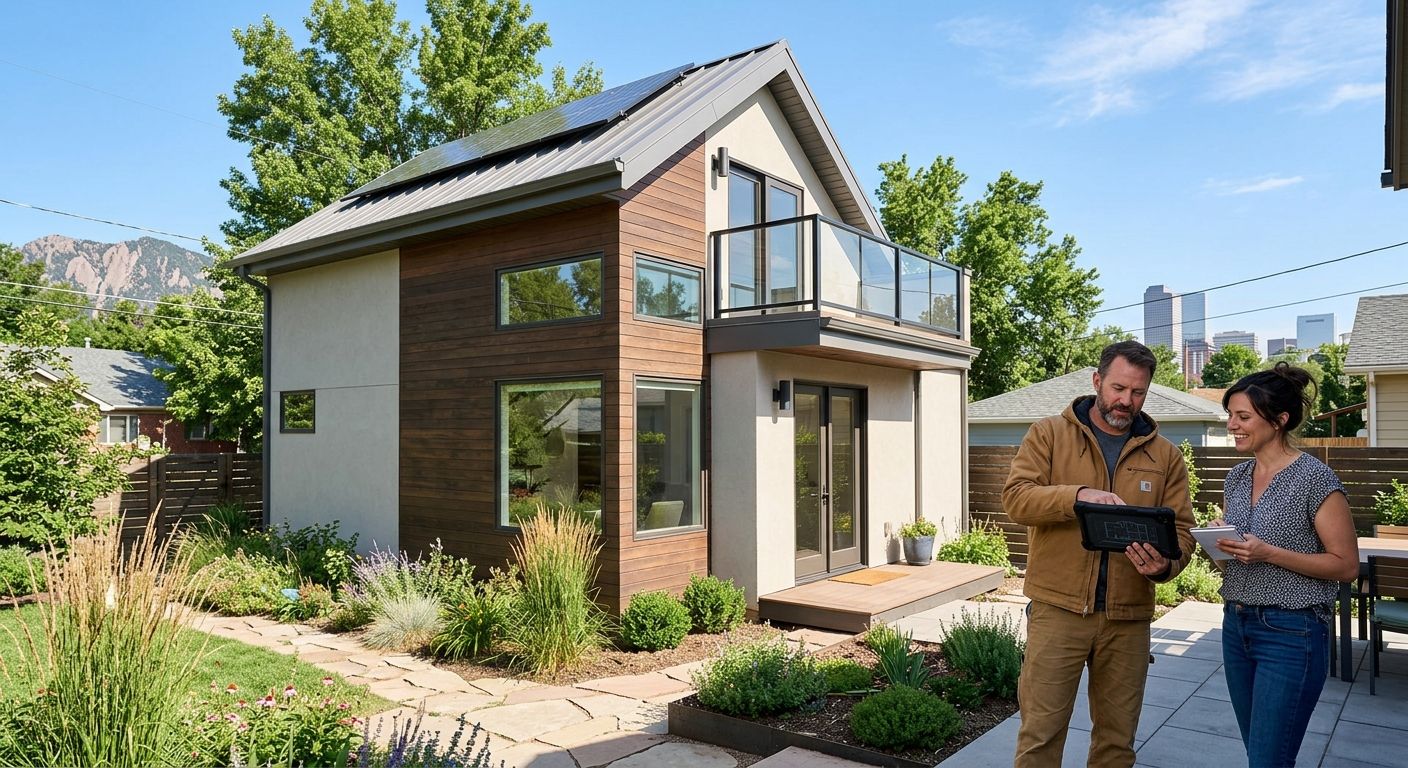
This comparison highlights how different ADU types suit different priorities — whether you value maximum privacy with a detached unit or seek the quickest path to rental income through a garage conversion. Choosing the right approach depends on your property layout, budget, and long-term goals. Our design-build team evaluates your site conditions and guides you toward the option that aligns with your vision while navigating local Denver Metro ADU development codes.
Ready to start? Request a Quote today, and we’ll provide a thorough assessment that accounts for your property’s unique characteristics. Call Us 24/7 at (720) 277-6568 to discuss your project.
Advanced Considerations for Custom ADU Design
Once you’ve settled on the basics, advanced custom ADU design opens up a world of possibilities that demand deeper site analysis, structural planning, and aesthetic coordination. With ADU regulations Colorado 2026 evolving rapidly, property owners in Denver Metro and throughout Colorado benefit from working with a design-build team that understands how upcoming mandates influence every design decision. Our approach at ACN Construction integrates regulatory awareness with creative problem-solving, ensuring your custom ADU meets both your vision and local requirements without unnecessary delays.
Lot constraints often dictate the most creative solutions in advanced ADU design. Setbacks, steep slopes, and awkward utility access points require specialized foundation systems rather than standard slabs. We frequently recommend helical piers for challenging soil conditions or tight access sites where traditional excavation would prove impractical. These engineered solutions provide stable, long-lasting support while minimizing site disturbance and preserving mature landscaping that homeowners value. Our team evaluates each property’s unique characteristics before proposing structural approaches.
The customization possibilities extend well beyond basic floor plans. We can help you explore energy-efficient net-zero-ready systems that reduce long-term operating costs while aligning with Colorado’s forward-thinking energy codes. Wellness features such as custom steam showers transform an ADU into a personal retreat, while premium exterior finishes like LP SmartSide siding deliver durability and curb appeal that complement your primary residence. These high-end options require careful integration during the design phase, which is precisely where our design-build model excels.
Our local permitting and code expertise helps clients navigate the regulatory landscape with confidence. The Colorado HB24-1152 implementation mandates introduce new considerations for ADU development across the state, and Denver Metro ADU development codes add municipality-specific zoning constraints that affect everything from maximum square footage to parking requirements. We guide clients through these requirements as part of our comprehensive design process, though permit, inspection, and fee requirements vary by jurisdiction and may affect schedule and cost.
The design-build model stands as a key differentiator for complex custom ADU projects. Single-point accountability means you communicate with one team from initial concept through final walkthrough, eliminating the finger-pointing that can occur between separate designers and contractors. This integrated approach reduces delays, clarifies communication, and keeps your project moving efficiently through each phase. As detailed in our About Us page, our team brings deep local experience to every custom ADU project, and as shown on our custom-homes page, we apply the same design-build rigor to custom ADUs that we bring to larger residential projects.
With these advanced design considerations in mind, the next step is to explore how local regulations and permitting requirements will shape your project timeline and budget. Our team stands ready to translate your vision into a buildable, code-compliant design. Let us help you get your project started.
Frequently Asked Questions About ADU Regulations
Now let’s address the most common questions homeowners have about building an accessory dwelling unit on their property in the Denver metro area.
What are the new ADU regulations in Colorado for 2026? Colorado is updating the ADU regulations colorado 2026 landscape through HB24-1152, which requires most metro municipalities to allow attached, detached, and internal ADUs by right on owner-occupied lots. The Colorado HB24-1152 implementation mandates take effect in mid-2025, with full compliance expected by 2026.
Can local cities opt out of these new state rules? Denver metro ADU development codes will still govern specifics such as setbacks, height limits, and lot coverage, and while cities cannot fully opt out of the state mandate, they may adopt reasonable local standards that do not effectively prohibit ADU construction.
Do I have to rent out my ADU? No—the law simply legalizes construction on qualifying lots and does not require homeowners to rent the unit. You may use it for family, guests, a home office, or any lawful purpose.
What permits will I need? Typical ADU projects require building, electrical, and plumbing permits. Permit, inspection, and fee requirements vary by jurisdiction and may affect schedule and cost. Please consult a licensed contractor for definitive advice; verify the license with the Colorado Department of Regulatory Agencies (DORA).
If you would like a personalized assessment of how these regulations apply to your property, we welcome you to request a quote today. Let us help you get your project started.
Start Your ADU Project with ACN Construction
Ready to navigate the latest ADU regulations in Colorado for 2026? ACN Construction is your local design-build partner. We provide single-point accountability for your entire project, from concept to completion. Our team stays current with Colorado HB24-1152 implementation mandates and Denver metro area ADU development codes so you don’t have to. about ACN construction and our commitment to clear communication and durable outcomes.
Contact us today for your custom quote—call us 24/7 or visit our contact page. Let us help you get your project started.
Estimates are preliminary and subject to change after site inspection and a full scope review.
Resources
- Get Streamlined Design-Build Service in Centennial
- Find Custom Home Construction in Centennial
- Learn About ACN Construction in Centennial
- Contact ACN Construction via Phone or Email
- Get Bathroom Renovation Services in Centennial
- Read ACN Construction Terms and Conditions
- View Privacy Policy for ACN Construction
- Access Denver City Services and Information Online